
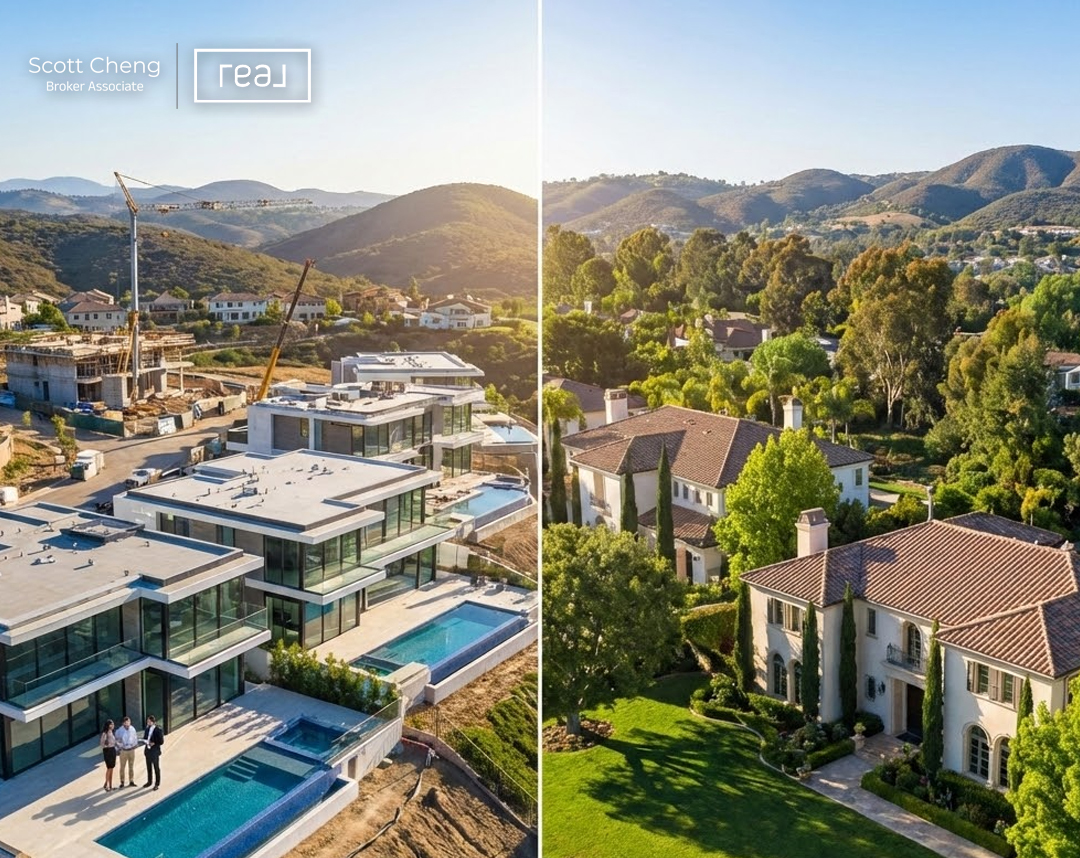
Luxury New Construction vs Resale Homes in Rancho Penasquitos and Scripps Ranch 2026: Which Offers Better Value and Negotiation Leverage for Buyers Ready to Close Over $1M
Luxury New Construction vs Resale Homes in Rancho Penasquitos and Scripps Ranch 2026: Which Offers Better Value and Negotiation Leverage for Buyers Ready to Close Over $1M?
New construction gives you efficiency, warranties, and upgrade credits, while resale delivers speed, landscaping, and room to negotiate on price or credits. In 2026, you gain leverage by timing and targeting micro-markets under tight 1 to 1.1 months of supply.
Why This Matters Right Now
You are competing in two of the best neighborhoods in San Diego for families and schools, with luxury demand outpacing supply. Local MLS and association data show Rancho Penasquitos around a $1.26M median in late 2025 and Scripps Ranch near $1.7M, with sale-to-list near 98 to 99 percent. That means you need a clear plan to capture value over $1M without overpaying. New construction typically asks a premium yet offers builder incentives. Resale moves quickly and can provide better total cost of ownership if you find inspection leverage. Your timing could save you six figures when you stack rate buydowns, credits, and careful due diligence. This advice also applies if you are comparing nearby Rancho Bernardo or Poway where school-driven demand and limited lots mirror these dynamics.
What You Need to Know Before You Choose New Construction or Resale Over $1M
You should anchor your decision in total cost, timeline, and leverage points unique to each path.
- Budget beyond price:
– New build premiums often run about 10 percent versus similar resale.
– Factor Mello-Roos where applicable, HOA dues, solar agreements, landscape, window treatments, and soft costs.
– Resale may need $25K to $150K in updates but can be offset with credits.
- Timing and certainty:
– New construction can take 10 to 12 months, plus potential delays.
– Resale offers immediate occupancy and faster wealth compounding if you deploy capital sooner.
- Negotiation levers:
– New builds often allow upgrade credits, rate buydowns, or closing cost help, especially on standing inventory.
– Resale offers room for price reductions or credits, commonly 3 to 5 percent when days on market rise or repairs surface.
- Inspection complexity:
– New construction requires careful warranty review, punch-list quality control, and third-party inspections.
– Resale requires enhanced inspections for roofs, foundations, pools, and smart systems.
- Financing:
– You will likely use a jumbo loan with 20 to 30 percent down. Lock a rate with flexible float-down and ask for lender letters that address appraisal gaps.
- Market posture:
– With 1.0 to 1.1 months of supply, you need escalation, appraisal gap strategy, and proof of funds to win. Local MLS data confirms quick absorption in 92129 and 92131.
Local nuance you should factor in
You will see micro-market splits by school zone, lot size, and proximity to canyons. A quiet cul-de-sac near Los Peñasquitos Canyon can command a premium, while homes near main throughways or with older roofs can become leverage points for credits and price adjustments.
How to Compare Your Options
You should compare apples to apples by modeling total cost of ownership over 5 to 10 years, not just list price. New construction shines with lower operating costs and builder warranties. Resale wins with immediate equity potential and mature landscaping that you cannot replicate at builder pricing.
Pros of new construction:
- Energy-efficient systems and modern layouts that reduce utility and renovation costs.
- Builder warranties that cap risk in the early years.
- Upgrade flexibility so you do not pay twice for finishes.
Cons of new construction:
- Premiums over comparable resale and potential construction delays.
- Ongoing builder site activity that can impact privacy and noise during build-out.
- Limited lot sizes in some tracts compared to older estates.
Pros of resale:
- Faster closing, established landscaping, and privacy on larger lots.
- More negotiating room on price or credits for aging systems.
- Character neighborhoods with walkable parks and community amenities.
Cons of resale:
- Higher maintenance risk without thorough inspections.
- Potential for competitive bidding on turnkey listings in top school pockets.
- Older mechanicals that may need sooner replacement.
Key factors to evaluate:
- Total cost of ownership over 5 to 10 years including taxes, Mello-Roos, HOA, utilities, updates, and financing costs.
- Timeline certainty and opportunity cost of waiting for a new build.
- Lot size, privacy, and view corridors that drive long-term resale value.
- School zoning for Poway Unified or San Diego Unified segments that support appreciation.
- Builder incentives versus resale credits and how each affects your net cash outlay.
- Resale potential in 3 to 7 years based on micro-market comps and buyer preferences for your floor plan.
Your Step-by-Step Guide to Maximizing Value and Leverage
1) Clarify your financial edge
- Secure a jumbo pre-approval with a local lender who knows these ZIP codes. Confirm reserves for 6 to 12 months and a written plan for appraisal gap coverage.
- Ask about buydowns or discount points and verify rate lock flexibility.
2) Build a data-driven short list
- Pull closed comps from local MLS for the last 90 to 180 days in your micro-neighborhood.
- For new builds, price out your exact upgrade package and add landscaping, window coverings, and soft costs.
3) Tour strategically
- Visit new construction models on weekdays and ask about standing inventory or canceled contracts.
- For resale, preview twice at different times of day to gauge traffic, noise, and light.
4) Craft a winning offer
- Use an escalation clause with a cap of 5 to 10 percent over list tied to a verifiable competing offer.
- Include an appraisal gap cushion that fits your loan and liquidity.
- Offer flexible closing terms, 30 to 45 days, and consider early release of a portion of your deposit when risk is low.
5) Leverage inspections intelligently
- Order enhanced inspections: roof, foundation, sewer scope, pool and spa, electrical panel capacity, and a smart home audit with thermal imaging.
- Ask for a seller credit for major items while covering minor fixes to keep goodwill.
6) For new construction quality control
- Hire a third-party inspector at pre-drywall and final walkthrough.
- Document punch-list items in writing and tie completion to final payment where possible.
- Review all builder warranties for structural, systems, and workmanship coverage including transferability.
7) Close and protect your investment
- Recheck property taxes and Mello-Roos, then set auto reserves for big-ticket systems.
- Keep maintenance logs and warranty documents to strengthen your resale position within 3 to 7 years.
What This Looks Like in Rancho Penasquitos and Scripps Ranch
You will find two distinct value stories. Rancho Penasquitos has seen a median around $1.26M with a 98 percent sale-to-list, and inventory close to 1 month. Scripps Ranch is tighter and more premium with a median near $1.7M and roughly 1.1 months of supply. Days on market diverge, with Rancho Penasquitos trending longer than Scripps Ranch, which often sees rapid absorption for single family homes. This split affects your leverage. You can often negotiate more in Rancho Penasquitos on homes with deferred maintenance, while in Scripps Ranch you may focus on appraisal gap strategy and flexible terms over price cuts.
New luxury tracts in Rancho Penasquitos commonly span 1,400 to 3,000 square feet with pricing from about $1.2M to $1.8M, and you can often find upgrade credits on standing inventory. In Scripps Ranch, infill near Miramar Reservoir and custom pockets around Vista Scripps cater to buyers who prioritize lot size, privacy, and access to parks.
Neighborhoods to consider in Rancho Penasquitos, Scripps Ranch:
- Park Village and Twin Trails in Rancho Penasquitos: Strong Poway Unified schools, canyon access, and family amenities. Expect roughly $1.2M to $1.8M with a mix of updated and value-add properties.
- Scripps Ranch Stonebridge Estates: Larger newer homes, cul-de-sacs, and community parks. Typically $1.6M to $2.3M depending on lot, upgrades, and views.
- Scripps Ranch near Miramar Reservoir and Scripps Ranch Villages: Tree-lined streets, quick park access, and shorter days on market. Expect about $1.4M to $1.9M depending on age and finish level.
Nearby Areas Worth Exploring
You may also compare adjacent markets that share similar schools, commute patterns, and luxury profiles.
- Rancho Bernardo: Larger inventory and golf course communities with strong Poway Unified ties. You often see slightly broader price bands and opportunities to negotiate on homes with dated finishes.
- 4S Ranch: Master-planned living with modern amenities and parks. Newer construction can reduce maintenance in your first years and provide strong family-friendly appeal.
- Poway: Estate-size lots and a semi-rural feel that delivers privacy and space. If you value acreage and outbuildings, you can find unique properties that differ from tract-based options.
What Most People Get Wrong
You might assume new construction always costs more and resale always negotiates better. In reality, your net outcome depends on incentives, timing, and property condition. Builders often protect base price but quietly move on upgrades, closing costs, and rate buydowns, which can erase a chunk of the premium. On the resale side, you may overpay by waiving inspections or skipping thermal imaging on a pool or roof that needs work. Another common miss is ignoring Mello-Roos and HOA structures. A lower purchase price can be outweighed by higher ongoing fees, while an efficient new home may reduce utilities enough to narrow the monthly gap. Finally, you may look only at house specs and not at micro-location. In these submarkets, a canyon rim, a quiet cul-de-sac, or a top school boundary can swing future resale value more than a single extra bedroom.
Frequently Asked Questions
Is new construction really more expensive in 2026 than resale in these areas?
Generally yes, new builds carry a premium of roughly 10 percent over comparable resale. You can offset this with builder incentives like upgrade credits and rate buydowns. Your net cost depends on the specific home, lot, and incentives available when you are ready to close.
How much can you negotiate on a $1.5M resale without losing the deal?
You can often achieve 3 to 5 percent in price or credits when days on market rise or inspections uncover major items. Lead with a strong, clean offer that includes proof of funds and flexible closing, then use inspections to secure targeted credits rather than across-the-board price cuts.
Does this advice apply to Rancho Bernardo and Poway too?
Yes. Rancho Bernardo and Poway share similar supply constraints and school-driven demand. You will find more variety in lot sizes and architectural styles, which can create additional negotiation angles on resale. Builder incentives and rate buydowns also appear in new construction or recent builds in those areas.
Which inspections do you need for luxury homes over $1M in these zip codes?
Beyond the standard general inspection, order a roof evaluation, foundation review, sewer scope, pool and spa certification, electrical panel and capacity check, HVAC assessment, and a smart home system audit with thermal imaging. These reports create leverage for credits and protect your long-term budget.
How do you structure an escalation clause without overpaying?
Cap your escalation 5 to 10 percent over list, require proof of the competing offer, and pair it with an appraisal gap cushion sized to your reserves. Keep inspection contingencies for major systems and consider early deposit release only after key risks are cleared.
The Bottom Line
If you want efficiency, warranties, and customization, new construction can be worth the premium when you secure upgrade credits, rate buydowns, and favorable closing costs. If you want speed, mature lots, and negotiation room, resale can deliver better total value when you leverage inspections for targeted credits. In Rancho Penasquitos and Scripps Ranch, ultra-tight supply means you win by modeling total cost of ownership, timing your offer, and optimizing terms. Whether you are focused on these neighborhoods or also considering nearby Rancho Bernardo and Poway, the same playbook applies. Compare net costs line by line, insist on enhanced inspections, and use your financing strength to control price, risk, and timeline.
If you’re ready to explore your options for luxury new construction or resale in Rancho Penasquitos and Scripps Ranch or nearby communities, Scott Cheng at Scott Cheng San Diego Realtor can walk you through the specifics for your situation.
📞 858-405-0002
DRE# 01509668
Leave a Reply