

First-Time Buyer Down Payment Assistance 2026: Chula Vista vs San Diego County Insights
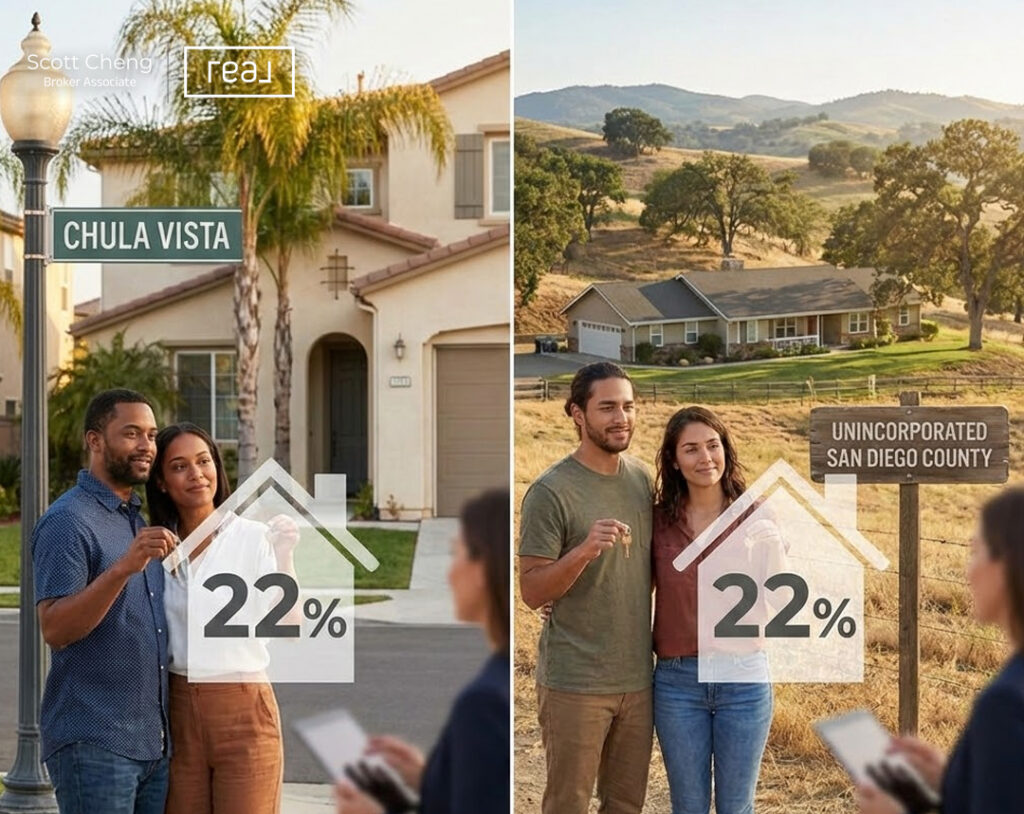
First-Time Buyer Down Payment Assistance in Chula Vista vs Unincorporated San Diego County 2026: Which Location Unlocks the Most Help (Up to 22%) Before You Commit to a Neighborhood?
Chula Vista usually unlocks more help upfront with up to 22 percent assistance capped at $120,000 and no lottery, while unincorporated San Diego County offers up to 17 percent plus up to 4 percent for closing costs. Your best choice depends on income limits, price caps, and stacking.
Why Does Down Payment Assistance Matter So Much for First-Time Buyers in San Diego Right Now?
Down payment assistance can be the difference between buying now and waiting another year. San Diego inventory sits near 2.5 months supply and the countywide median remains close to $900,000, which means first-time buyers competing in the $600,000 to $900,000 range with 3 to 10 percent down face a very tough math problem without outside help.
The 2026 cycle also brings a renewed CalHFA Dream For All program registration window in late February to mid March, which can fund up to 20 percent if you qualify as a first-generation buyer. You will want a location strategy that lines up with programs you can actually win and close on in time.
Whether you are focused on Chula Vista or also considering nearby National City and Bonita, your decision should be program led. In some neighborhoods you can get more percentage but run into a lower dollar cap. In others you can stack multiple sources within lender limits. Your timing could be the difference between closing with 3 percent out of pocket or sitting on the sidelines another year.
What Do You Need to Know Before Choosing Between Chula Vista and San Diego County for Down Payment Assistance?
You need to match your target neighborhood to the assistance rules that govern it, because programs are jurisdiction based and boundaries matter significantly.
A home in the City of Chula Vista unlocks the San Diego Housing Commission’s Chula Vista deferred loan. A home in unincorporated San Diego County unlocks the County CalHome DCCA option. Both can sometimes be layered with statewide CalHFA support if you fit the rules.
Key facts for 2026 you should anchor on:
- Chula Vista deferred loan: up to 22 percent of price with a $120,000 cap, 3 percent simple interest, payment deferred up to 30 years or until sale or refinance. No lottery. Buyer funds requirement often 3 percent.
- County CalHome DCCA for unincorporated areas: up to 17 percent of price plus up to 4 percent for closing costs, typically at 3 percent simple interest deferred. Buyer funds requirement often 3 percent. No city price cap beyond lender and program underwriting.
- Statewide CalHFA Dream For All: up to 20 percent assistance with a cap near $150,000, shared appreciation repayment, first-generation requirement, and a time-bound registration window in early 2026. You may be selected by lottery.
- Income limits: local deferred programs generally require income at or below 80 percent of area median income, while CalHFA allows higher limits in San Diego County.
- Price caps: Chula Vista and other city-administered programs often set a maximum purchase price near the conforming limit for the region, commonly about the $800,000 range. County CalHome typically does not add a separate cap beyond lender approval.
You should also understand repayment types. Deferred loans accrue simple interest and are repaid at sale. Shared appreciation loans repay principal plus a percentage of your gain, which can feel cheap upfront but can cost more if values rise.
Quick math you can use
- $750,000 purchase in Chula Vista: 22 percent potential equals $165,000, but the cap limits you to $120,000.
- $750,000 purchase in unincorporated county: 17 percent equals $127,500, plus up to 4 percent for closing costs. The combined assistance can exceed $120,000 if your file qualifies.
- With CalHFA Dream For All at 20 percent: $150,000 on a $750,000 price. You could add a local deferred loan if stacking rules allow, often not exceeding about 40 percent of price.
How Do You Compare Down Payment Assistance Options Side by Side in 2026?
You should compare by both percentage and dollars, and by how quickly the funds can be secured. A slightly smaller award that you can close on today can be better than a bigger award tied to a lottery that might not select you.
What to weigh side by side:
- Assistance percentage vs dollar cap: Chula Vista shows the higher percentage but is capped at $120,000. On higher prices the cap can make Chula Vista’s 22 percent feel closer to 16 percent in practice.
- Time to funds: Chula Vista and County programs are pipeline based. Dream For All requires lottery selection and reservation steps that can push timelines. In multiple offer situations, you need a lender and program team that can clear conditions fast.
- Repayment structure and future equity: Deferred loans at 3 percent simple interest are predictable. Shared appreciation rises with the market. If you expect strong home price growth, a standard deferred loan may leave you with more equity at resale.
- Income and price filters: At 80 percent AMI, many mid-income households will be pushed toward CalHFA rather than city or county programs.
- Stacking and lender overlays: Programs and lenders may cap total combined assistance to about 40 percent loan to value from subordinate financing. You need written confirmation from your lender.
- Property location boundaries: A Chula Vista mailing address is not enough. Bonita, Otay Ranch, and Eastlake include areas inside and outside city boundaries. Unincorporated pockets near Spring Valley and Lakeside can qualify for County support even if they share a zip code with a city.
Key factors to evaluate:
- Eligibility fit today vs hypothetical future eligibility
- Your target price point relative to each program’s cap
- The tradeoff between shared appreciation and simple interest for your 5 to 10 year plan
What Is the Step-by-Step Process to Apply for Down Payment Assistance as a First-Time Buyer in San Diego?
You can tilt the odds in your favor by aligning your paperwork, program targeting, and offer strategy in a specific order. Follow these 10 steps to maximize your chances of closing with assistance.
1) Clarify your target purchase price and payment comfort
- Set a budget that keeps your debt to income at or below 45 percent. Your goal is a sustainable payment, not just a preapproval max.
2) Choose a primary assistance pathway
- If you are first generation and within CalHFA limits, register for Dream For All during the February to March window. If not, anchor on Chula Vista or County CalHome depending on your target neighborhoods.
3) Prequalify with the right lender
- Work with a CalHFA approved lender that also funds SDHC and County deferred loans. Ask about stacking rules, maximum combined assistance, minimum credit scores, and whether they can close with subordinate liens in 30 days.
4) Complete homebuyer education
- Finish HUD approved education early. Local programs will require your certificate. Do not wait until you are in escrow.
5) Run a three-way eligibility screen
- Confirm income and purchase price eligibility for CalHFA, Chula Vista, and County CalHome. If you are close to a boundary, confirm the parcel is in the city or unincorporated area in writing.
6) Model repayment scenarios
- Scenario A: Chula Vista 22 percent up to $120,000 at 3 percent simple interest.
- Scenario B: County 17 percent plus up to 4 percent closing at 3 percent simple interest.
- Scenario C if applicable: Dream For All 20 percent shared appreciation.
Compare 7 year costs and estimated equity at 3 to 4 percent annual price growth using FHFA regional price trends as a guide.
7) Prepare your document stack
- Two years W2s and tax returns, last 60 days assets, most recent pay stubs, gift letters if any, and a clear paper trail for earnest money. Subordinate programs will scrutinize your funds to close.
8) Align your offer strategy
- Choose properties that appraise cleanly and do not need heavy repairs, since many assistance programs will not allow major health and safety issues. Write offer terms that reflect the need for subordinate lien approval.
9) Lock timelines with all parties
- Get the subordinate lien approval timeline in writing and share it with the listing agent. Certainty helps you win in sub $1 million price points that move quickly.
10) Stay program current
- Limits, caps, and windows can adjust midyear. Ask your lender to reconfirm program sheets just before you write offers.
Which San Diego Neighborhoods Work Best With These Down Payment Assistance Programs?
The right neighborhood depends on how well its price range aligns with each program’s caps. Chula Vista’s program works best where the $120,000 cap covers close to the full 22 percent, while County CalHome shines in more affordable inland communities.
Chula Vista’s program can be powerful for townhomes and smaller single family homes in Eastlake and Otay Ranch, where many entry level condos and townhomes trade in ranges where the cap is less of a constraint. If your search drifts higher into single family homes around the city’s top school pockets, the cap can bite and your effective percentage drops.
In unincorporated San Diego County, the County CalHome path can work well in parts of Spring Valley, Lakeside, Ramona, and San Diego Country Estates where prices are often more approachable than core coastal areas. The 17 percent down assistance plus closing cost support can reduce your cash to close sharply.
Recent local reports show a county median near $900,000, with single family detached homes closer to $1.1 million and attached homes around the high $600,000s. The best real estate agent San Diego buyers hire will blend program expertise with local market knowledge so you do not overpay on a property that strains your cap.
Neighborhoods to consider in San Diego:
- Chula Vista Eastlake and Otay Ranch: Strong master planned amenities, newer townhomes and condos, and proximity to the Blue Line Trolley. Works well with Chula Vista assistance for many entry prices.
- City Heights: Relative affordability for central San Diego, quick access to the Orange and Green lines, and walkable corridors. Consider CalHFA layering here if you qualify as first generation.
- North Park: Popular for walkability, parks like Morley Field, and central access. Price points trend higher, so lean on CalHFA and conventional 3 to 5 percent options if local program caps are too tight.
What Nearby South Bay Communities Should First-Time Buyers Also Consider?
Adjacent South Bay communities offer similar commute patterns and school districts while sometimes presenting better price-to-assistance alignment than core Chula Vista. These areas are worth exploring if your Chula Vista search feels constrained by pricing or program caps.
- National City: Close to downtown job centers and the Blue Line. Price points can be slightly lower than parts of Chula Vista. If you want a shorter commute with condo options, this can be a smart alternative.
- Bonita: Semi rural feel with larger lots and trail access. Portions are unincorporated, which can open County CalHome eligibility. If you want more space without going far inland, keep Bonita on your list.
- Imperial Beach: Coastal lifestyle at a more approachable price than central beach areas. If you want beach proximity without La Jolla pricing, you can pair CalHFA with a primary loan and compare monthly payment to South Bay suburbs.
What Are the Most Common Mistakes First-Time Buyers Make With Down Payment Assistance in San Diego?
The most common mistake is assuming the highest percentage automatically equals the best program — in practice, caps and repayment structures often flip that assumption on higher-priced purchases.
You also might think shared appreciation is always cheaper because the rate feels invisible. Over a 7 to 10 year hold, a rising market can make shared appreciation costlier than a fixed 3 percent simple interest deferred loan.
Another common mistake is missing boundaries. A property that looks like Chula Vista might sit just outside city limits. That can flip your entire program plan. You also want to avoid waiting on a lottery without a Plan B. If you are aiming for Dream For All, you should run a parallel local program preapproval so you can write competitive offers if your ticket is not drawn. Finally, watch lender overlays. Not every real estate broker San Diego buyers work with has a lending partner that will stack assistance to the full allowed limit, and that can cost you thousands.
Frequently Asked Questions
Which location tends to unlock the most assistance on a 750,000 dollar purchase in 2026?
Chula Vista often delivers the most assistance if your price is low enough that the $120,000 cap approximates 22 percent. On higher prices, the County’s 17 percent plus closing cost support can match or exceed total dollars. Your income and stacking options decide the winner.
Can you stack CalHFA Dream For All with Chula Vista or County CalHome?
Yes, you can often stack within each program’s rules and your lender’s overlays. Total subordinate financing is commonly limited to about 40 percent of the price. You need written confirmation on the exact combination for your file and property type before you write offers.
Does this advice apply to National City and Bonita too?
Yes. National City may have its own city program parameters administered locally, and Bonita includes unincorporated pockets that can qualify for County CalHome. You should verify city boundaries and program availability by parcel and then run the same percentage vs cap analysis.
How fast can you secure down payment assistance funds without hurting your offer timeline?
Local deferred programs can be underwritten and funded within a standard 30 to 45 day escrow if your documentation is complete. Dream For All requires registration and selection, then reservation, which can add steps. Align timelines early with your lender and the listing agent to maintain offer strength.
What credit score and DTI should you target to qualify smoothly for down payment assistance?
Aim for a mid 600s score or higher and a debt to income below 45 percent. Some assistance programs and lenders accept lower scores, but better credit improves pricing, speeds underwriting, and expands your program options. Stable income and clean asset documentation are just as important.
The Bottom Line
If you need the most help upfront and you are buying where the $120,000 cap still delivers close to the full 22 percent, Chula Vista is usually your best bet. If your target price is higher or your ideal property sits outside city limits, unincorporated San Diego County’s 17 percent plus closing cost support can be the smarter play. If you qualify as first generation, add CalHFA Dream For All to your plan and compare the long term cost of shared appreciation to 3 percent simple interest. Whether you are focused on Chula Vista or also exploring National City and Bonita, the winning strategy is to match your neighborhood shortlist to the programs you can actually close on in the current market.
If you’re ready to explore your options for down payment assistance in the San Diego area or nearby communities, Scott Cheng at Scott Cheng San Diego Realtor can walk you through the specifics for your situation.
📞 858-405-0002
DRE# 01509668