
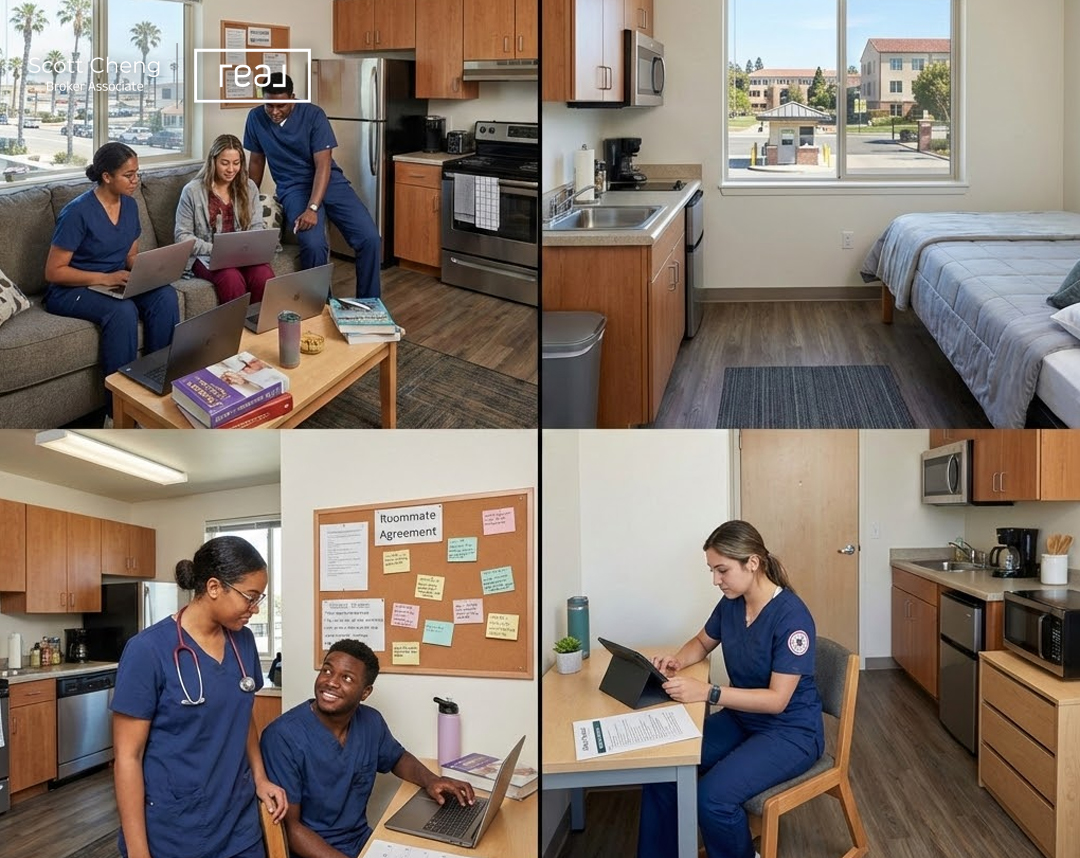
Shared Housing vs Studio Apartments for College Nursing Students in Oceanside 2026: Cost Comparison and How to Choose Safe Options Near Campus Before Roommate Agreements
Shared Housing vs Studio Apartments for College Nursing Students in Oceanside 2026: Cost Comparison and How to Choose Safe Options Near Campus Before Roommate Agreements
In Oceanside for 2026, shared rooms near MiraCosta average $1,200 to $1,600 per person, while studios run about $1,700 to $2,100. Choose shared for savings and community, studios for privacy and quiet, and vet safety before any roommate agreement.
Why This Matters Right Now
You’re facing tight rental supply, rising demand near hospitals, and a spring leasing surge. Local MLS and regional rent indexes show Oceanside’s average rent sitting below Carlsbad and near regional norms, while studios close to campuses and Tri-City Medical Center see the most competition. If you’re a nursing student or healthcare worker in clinical rotations, your schedule means you need quiet, safe, and flexible housing with reliable transit or short commutes. Your timing could decide whether you lock a studio under $2,100 or end up stretching your budget. You also need to balance roommate dynamics with sleep-friendly policies and safety features that protect you on late returns. This same playbook applies if you’re also considering adjacent areas like Vista and San Marcos, where prices and commute times can shift your decision. With North County’s sellers’ market for single-family homes and steady condo supply, rentals near hospitals and campuses move quickly, so you’ll want a clear plan before you tour.
What You Need to Know Before You Pick Shared Housing or a Studio
You should define your budget, commute, and non-negotiables before you start. In 2026, shared housing near MiraCosta and Tri-City Medical Center commonly ranges $1,200 to $1,600 per person for a private room in a house or condo. Studios in Oceanside typically land around $1,700 to $2,100 depending on proximity to the beach, transit, and campus. Carlsbad averages higher rent overall, while Solana Beach trends toward premium pricing and longer market times.
Key takeaways:
- Your budget: RNs often target $2,500 to $3,500 monthly, while LPNs or techs target $1,500 to $2,200. You’ll want to keep total housing near 30 to 35 percent of gross income.
- Lease type matters: Month-to-month or 3 to 6 month furnished terms can fit rotations. Ask for early check-in or flexible move-out aligned with clinicals.
- Deposits and fees: State law now limits most residential security deposits to one month of rent. Ask to align pet deposits with this cap and request that monthly pet rent be waived or reduced.
- Utilities and extras: In shared homes, clarify utility splits, cleaning supplies, internet, and consumables. In studios, confirm parking, package lockers, and quiet hours.
- Noise and sleep: You need blackout shades, white noise options, and written quiet hours. Test ambient noise at midnight and 5 a.m.
- Transit and parking: If you rely on the Coaster or bus, prioritize units within a 10 to 12 minute walk. If you drive, negotiate a reserved spot.
Quiet and Safety Checklist You Should Use
- Deadbolts, window locks, exterior lighting, and cameras covering entries.
- Smoke and carbon monoxide detectors in place and tested.
- No signs of moisture intrusion, mold, or rusted plumbing (coastal humidity risk is real).
- HVAC or mini-split systems serviced, filters clean, and vents dust free.
- Hallways and exterior paths well lit, with clear sightlines to parking.
How to Compare Your Options
You should evaluate total cost of living, then layer in sleep quality and safety. In shared housing, you’ll likely save $300 to $600 per month compared with a studio, but you’ll need house rules tailored to shift work. In a studio, you’ll pay more for privacy and control, often worth it if you’re in an ICU, ED, or any role that demands uninterrupted rest. Market indicators from local MLS, FHFA, and regional rent indices suggest steady demand near Tri-City Medical Center and the Oceanside Transit Center, so you’ll want to move decisively when a unit fits.
Pros of shared housing:
- Lower monthly cost and often larger kitchens, patios, and laundry.
- Built-in support community, helpful for study and swapping shifts.
- More options within walking or biking distance of campus.
Cons of shared housing:
- Roommate noise and inconsistent house standards.
- Utility and cleaning disputes unless rules are written.
- Fewer private work and sleep zones.
Pros of studios:
- Maximum control over quiet hours, visitors, and cleanliness.
- Easier to reset circadian rhythm after nights.
- Fewer surprises with utilities and rules.
Cons of studios:
- Higher base rent and deposits.
- Smaller living space and limited storage.
- Fewer chances to split costs or rides.
Key factors to evaluate:
- All-in monthly cost including utilities, parking, laundry, and internet.
- Sleep guarantees: quiet hours, noise level at night, and sound insulation.
- Safety: lighting, locks, neighborhood crime trends, and building access.
- Commute: minutes door to door for day and night shifts.
- Flexibility: lease term, extensions, and subletting rules.
- Management: response times under 24 hours and clear maintenance process.
Your Step-by-Step Guide
1) Set your budget. Use a 30 to 35 percent of gross income target. Include utilities, parking, pet rent, and renter’s insurance.
2) Choose your radius. Map commutes to MiraCosta, Tri-City Medical Center, and clinical sites. Aim for under 20 minutes door to door at peak and off-peak.
3) Shortlist neighborhoods. In Oceanside, compare Townsite near the beach for energy and amenities with 92058 near Camp Pendleton for value. In Carlsbad, look at Calavera Hills or Hedionda-adjacent pockets for quieter streets.
4) Pre-screen listings. Require photos of windows, locks, bathrooms, HVAC, and parking. Ask for a sample lease and house rules before touring.
5) Tour at night. Visit after 9 p.m. and again early morning to test noise, lighting, and parking. Stand near windows to check street noise.
6) Verify management. Ask average work-order response time and weekend coverage. Require a named contact with a direct phone number, not just a generic mailbox.
7) Interview housemates. Align on quiet hours, guests, smoking or vaping, kitchen use, cleaning schedules, and parking.
8) Run checks. With permission, verify references and employment or student status. Use simple screening tools and avoid sharing unnecessary personal data.
9) Negotiate essentials. Ask for capped security deposit at one month, free reserved parking, and pet rent reductions. Tie any concessions to a 12 month term if you’re staying put.
10) Put it in writing. Finalize house rules as a roommate agreement before you sign the lease addendum. Include conflict resolution steps and what happens if someone leaves early.
11) Plan your move. Request a written move-in checklist with photos. Test detectors, locks, and HVAC on day one.
12) Reassess at 60 days. If sleep quality or safety falls short, use your extension or exit clauses to adjust.
Throughout the process, you can lean on a real estate agent san diego ca or a san diego broker for neighborhood-level intel. If you want to compare the best neighborhoods in San Diego for students and healthcare workers, you’ll get more clarity by touring day and night and documenting noise readings.
What This Looks Like in Oceanside, Carlsbad, and Solana Beach
In Oceanside, you’ll find the widest range of options near MiraCosta and Tri-City. Shared rooms typically run $1,100 to $1,600 per person in houses or townhomes, with studios at about $1,700 to $2,300 depending on proximity to the beach, Coaster access, and building age. Townsite and neighborhoods close to the Oceanside Transit Center offer car-light living, though nightlife can raise noise levels. The 92058 area near Camp Pendleton skews more budget friendly and family oriented.
Carlsbad generally carries higher average rents, yet you can still find shared housing in the $1,300 to $1,900 range per person with larger floor plans and quieter, master-planned streets. Studios often slot around $2,100 to $2,700 if you’re inland from the coast. Calavera Hills and pockets near Hedionda Lagoon are good for sleep-friendly environments and trail access. If your clinical sites are in Carlsbad or Encinitas, the commute balance may justify the premium. When you evaluate the best neighborhoods in San Diego to live for quiet study, these Carlsbad enclaves often rise to the top.
Solana Beach sits at the higher end of coastal pricing. You’ll pay roughly $1,400 to $2,000 per person for shared rooms, with studios more commonly in the $2,400 to $3,200 range near Fletcher Cove or the Cedros Design District. The vibe is calm, and you gain easy access to the Coaster for hospital commutes. If you prize walkability and low noise over pure price, this can work for you. For students asking about the best beach neighborhoods in San Diego with strong transit, Solana Beach checks key boxes.
Across these cities, local MLS and FHFA trends still show a lean single family supply and neutral to slight seller tilt for condos, which supports steady rental demand. You should move promptly on a unit that fits your priorities.
Neighborhoods to consider in Carlsbad, Oceanside, Solana Beach:
- Calavera Hills, Carlsbad: Sleep friendly streets, parks, and quick access to I-5. Shared rooms $1,300 to $1,900, studios $2,100 to $2,600.
- Townsite, Oceanside: Walkable to the pier and transit. Shared rooms $1,200 to $1,700, studios $1,900 to $2,300. Nightlife can add noise.
- Cedros District area, Solana Beach: Quiet coastal pocket, Coaster access, boutique amenities. Shared rooms $1,500 to $2,000, studios $2,500 to $3,100.
Nearby Areas Worth Exploring
- Vista: You’ll usually pay less than Oceanside while staying within a short drive to Tri-City and MiraCosta. Older homes can mean bigger shared living spaces and yards for pets. If you’re comparing the best neighborhoods around San Diego for value, Vista is a standout.
- San Marcos: Close to Cal State San Marcos and Palomar Medical Center, with a strong student housing ecosystem. Studios and shared units often undercut Carlsbad while offering newer builds near retail and trails.
- Encinitas: Pricier than Oceanside but quieter at night with strong coastal amenities. If you want the best neighborhoods in San Diego to walk and decompress between shifts, certain Encinitas pockets deliver.
What Most People Get Wrong
You might assume splitting rent automatically saves the most. In reality, utilities, parking, cleaning, and pet rent can erase your savings unless you negotiate and write clear house rules. Another common mistake is touring only during the day. You should test noise at night and at shift-change hours to ensure your sleep window stays protected. Many renters also skip a moisture check along the coast. You should inspect bathrooms, windows, and closets for condensation or musty odors that hint at mold. Finally, you’ll want to secure a reserved parking spot where street parking is scarce. Without it, your off-hours arrivals mean circling the block when you most need rest. If you plan to rely on transit, verify Coaster and bus schedules for late returns. Your best option is to confirm these details up front, then commit to a unit that protects your health and schedule.
Frequently Asked Questions
What’s cheaper in Oceanside for 2026, shared housing or a studio?
Shared housing is usually $300 to $600 less per month per person than a studio near campus or Tri-City. Expect $1,200 to $1,600 for a private room in a shared home versus $1,700 to $2,100 for a studio. Your all-in cost depends on utilities and parking.
How do you verify safety in a shared house near MiraCosta?
Start with locks, lighting, and detectors, then check windows and exterior sightlines to the parking area. Ask for recent maintenance logs, confirm smoke and carbon monoxide detectors, and tour after dark to test lighting, noise, and entry visibility.
Does this advice apply to Vista and San Marcos too?
Yes. Vista often delivers lower rents with larger shared homes, while San Marcos offers newer stock near medical and university campuses. The same safety and sleep criteria apply. You should compare commute times and transit options before you decide.
How can you negotiate lease concessions like parking or pet costs?
Lead with market data and offer a longer lease term in exchange for a reserved parking space, reduced pet rent, or a capped deposit. State law limits most residential security deposits to one month of rent, so request alignment with that cap.
Are furnished short-term options worth it for rotating clinicals?
They can be if you need flexibility and turn-key setups. You’ll often pay higher monthly rates and cleaning fees, but you save on furniture and can match your lease to rotation dates. Ask for fee caps and a clear extension policy with 30-day notice.
The Bottom Line
Shared housing near campus and hospitals can save you $300 to $600 per month and offer built-in support, while studios protect your sleep with maximum privacy and predictable rules. In Oceanside, typical 2026 ranges are about $1,200 to $1,600 per person for shared rooms and $1,700 to $2,100 for studios, with Carlsbad running higher and Solana Beach at the premium end. Your best choice comes from a hard look at all-in costs, safety, noise, and commute. Whether you’re focused on Oceanside or exploring nearby Vista and San Marcos, you’ll want to tour at night, verify management response times, and sign your roommate agreement before you commit.
If you’re ready to explore your options for shared housing vs studios in Oceanside and North County Coastal, Scott Cheng at Scott Cheng San Diego Realtor can walk you through the specifics for your situation. You can also lean on a real estate agent san diego ca, a top realtor in san diego, or a real estate broker san diego for hyperlocal insights across the best neighborhoods in San Diego.
📞 858-405-0002
DRE# 01509668
You can use this framework with top san diego real estate agents, a best san diego realtor, or the best real estate companies in san diego to compare the best neighborhoods in san diego for families, the best beach neighborhoods in san diego, and popular neighborhoods in san diego. When you evaluate neighborhoods to stay in san diego or the best places to live in san diego area, this process helps you move confidently and protect your sleep, safety, and budget. For deeper neighborhood comparisons across top real estate brokers in san diego, real brokerage san diego, and top real estate teams in san diego, you’ll get clarity by touring day and night, confirming commute times, and documenting noise and safety benchmarks before you sign.
Leave a Reply