Top Cash Flow Neighborhoods for Real Estate Investments in San Diego 2026: City Heights & More
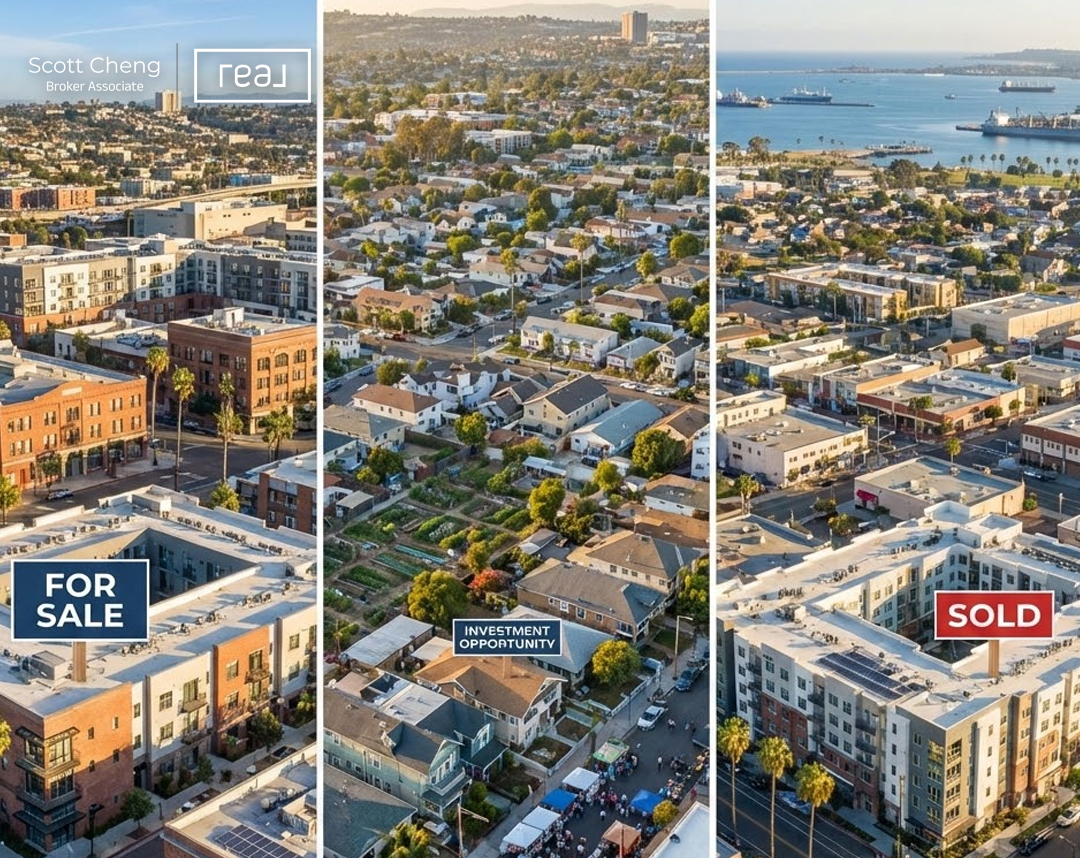
Best Neighborhoods for Cash Flow Real Estate Investments in San Diego 2026: Barrio Logan vs City Heights vs National City for Investors Ready to Buy Before Rates Drop
What are the best neighborhoods for cash flow real estate investments in San Diego in 2026, and how do Barrio Logan, City Heights, and National City compare if you want to buy before rates drop?
City Heights delivers the strongest cash flow in 2026 at roughly 6.3% average cap rates, with Barrio Logan close behind at 5.8% and National City near 5.2%. If you plan to buy before rates drop, prioritize City Heights value-add 2-10 unit assets.
Why does the San Diego investment market create a narrow window for buyers in 2026?
Inventory is critically low and prices are rising, meaning any rate relief will bring more competition fast. San Diego’s median sale price hit about $875,000 in January 2026 after climbing 5.8% year over year, while inventory sits near 1.8 months of supply — far below a balanced 4 to 6 months.
You are staring at a narrow window. Any meaningful rate relief could pull more buyers off the sidelines and push prices higher. As informed by the FHFA metro HPI reports, this dynamic can impact future valuations. Rents remain firm with roughly half of households renting, average apartment rents near 2,300 dollars, and vacancy around 3.6 percent. As an investor, your timing could lock in better basis and stronger cash flow before the next competitive wave.
You also want neighborhoods that work if you pursue buy-and-hold or value-add strategies. Barrio Logan, City Heights, and National City each offer different tenant profiles, price points, and cap rates. The same playbook often applies if you are also weighing adjacent areas like Chula Vista and North Park. Your goal is to secure stable income now and position for upside when credit loosens and cap rates compress.
What key market data should you know before choosing a San Diego investment neighborhood?
You need to understand citywide rent and price benchmarks before narrowing to a specific neighborhood. Rents average roughly $2,300 with vacancy near 3.6%, and inventory near 1.8 months means well-priced multifamily trades quickly.
You should narrow your strategy before you narrow your zip code. Prices, rents, and cap rates vary by block, but a few facts can speed up your decision.
- Market backdrop you can bank on:
– Median sale price about 875,000 dollars in Jan 2026, up 5.8 percent year over year.
– Inventory near 1.8 months, so well priced multifamily trades quickly.
– New listings are up modestly while pending sales are slightly softer, which signals room to negotiate with motivated sellers.
– Rents average roughly 2,300 dollars with vacancy near 3.6 percent, supportive for cash flow.
- Neighborhood-level cash flow signals:
– City Heights averages about 6.3 percent cap rates, with median 2-bed rents near 2,100 dollars and median purchase prices around 525,000 dollars for smaller assets.
– Barrio Logan averages about 5.8 percent caps, median 2-bed rents near 2,400 dollars, median purchase around 550,000 dollars, and a strong walkable arts district.
– National City averages about 5.2 percent caps, median home prices around 650,000 dollars, and steady 2-bed rents near 2,000 dollars.
- Your likely budget and financing mix:
– Typical entry for 2 to 10 units runs about 500,000 to 2 million dollars.
– Agency-style fixed options and local bank bridge loans are both in play. Many investors use 65 to 80 percent leverage depending on loan type and asset condition.
- Policy and value-add angles:
– The City of San Diego ADU Incentive Program waives select fees through December 2026, which can juice returns if your lot qualifies.
– Class B and C assets still price to 4.8 to 5.6 percent caps on average, and light renovations can add 6 to 8 percent in revenue upside.
Your job is to match tenant demand, transit access, and renovation scope to a realistic business plan that pencils at today’s rates.
How do you compare Barrio Logan vs City Heights vs National City for cash flow investing?
Score each neighborhood across cash flow today, rent growth durability, and operational risk to find the best fit. City Heights leads on yield, Barrio Logan on walkability and rents, and National City on lower entry cost per door.
You will make better decisions if you score each neighborhood across cash flow now, rent growth durability, and operational risk. Here is how to think about the tradeoffs.
- City Heights
– Strengths: Highest published average cap rate of the three at roughly 6.3 percent. Deep renter pool, strong transit and bus access, and constant demand for affordable 1 to 3 bed units. Ample value-add stock for cosmetic upgrades and ADUs where feasible.
– Risks: Older building systems can inflate capex. Turnover management matters. Street-by-street variation requires precise comping.
- Barrio Logan
– Strengths: Walk score in the low 80s, emerging arts and food scene, and proximity to Downtown and the bay. Median 2-bed rents near 2,400 dollars support a 5.8 percent average cap rate. Adaptive reuse and warehouse-to-loft conversions create unique product that rents well.
– Risks: Pricing has moved up with the neighborhood’s momentum. You should model conservative rent growth and budget for higher finish levels to match tenant expectations.
- National City
– Strengths: Entry price points are often lower on a per-unit basis within older multifamily stock. Access to major employment hubs and easy freeway connectivity. Operations can be simpler with stable, long-term tenants.
– Risks: Average cap rates near 5.2 percent lag City Heights. Industrial adjacency on certain corridors can limit rent premiums. Carefully vet noise and traffic impacts.
Key factors to evaluate:
- Basis relative to rent comps: You want to buy under replacement cost with a clear path to market rents within 12 months.
- Transit and employment access: Trolley and bus coverage, plus short commutes to Downtown or Mission Valley, correlate with occupancy and renewal rates.
- Value-add scope vs timeline: Plan a 9 to 12 month improvement schedule for classic-to-modern turns. Ensure you can maintain at least break-even cash flow during work.
What is the step-by-step playbook for buying San Diego investment property before rates drop?
Follow a tight 9-step sequence to compress risk and time-to-cash-flow. Start by underwriting at today’s rates, set a clear purchase box, and execute with discipline from day one.
You will compress risk and time-to-cash-flow if you follow a tight sequence.
1) Underwrite at today’s rates, not tomorrow’s. Stress test pro formas at a 50 to 100 basis point higher interest rate. If the deal still cash flows, you will get a bonus if rates ease.
2) Set a clear purchase box. For example, 2 to 10 units, 500,000 to 2 million dollars, minimum 5.75 percent going-in cap, upside to 7 to 9 percent through turns and ADUs.
3) Build your rent roll assumptions. Pull rent comps for like-kind units within half a mile. Use current average rents near 2,300 dollars citywide as a top-down reality check, then refine by submarket: about 2,400 in Barrio Logan, about 2,100 in City Heights, about 2,000 in National City for 2-bed units.
4) Verify zoning and ADU feasibility. The ADU Incentive Program through December 2026 can reduce soft costs. Lot size, setbacks, and utilities drive feasibility and timeline.
5) Estimate capex with contingency. For classic 1960s to 1980s stock, plan 10 to 20 percent of purchase price for unit turns, roofs, plumbing, and electrical. Add a 10 percent contingency.
6) Choose financing to fit the business plan. Fixed, longer-term debt suits buy-and-hold at 65 to 75 percent LTV. Bridge loans at 65 to 70 percent LTV suit heavy value-add with clear exit to refinance or sale.
7) Secure property management early. Shortlist firms with multifamily and ADU experience. Require monthly reporting, rent-up timelines, and vendor pricing in writing.
8) Negotiate credits and timelines. With pending sales softer than last year, you can push for repair credits, rate buydowns, or extended diligence to finalize ADU checks and environmental reviews.
9) Execute with discipline. Start turns on day one, stage permit applications early, and plan leasing to hit peak demand windows.
What do real-world cash flow examples look like for San Diego multifamily investments in 2026?
Real deal examples show City Heights and Barrio Logan hitting 6%+ modeled caps, while National City requires value-add execution to reach stabilized returns. Conservative underwriting is essential in all three markets.
When you translate data into a real-world purchase, you should measure cash flow with conservative rents and real expenses.
- City Heights example
– 6-unit at 1.9 million dollars, asking cap 6.8 percent on broker materials.
– Pro forma: 6 units x 2,100 dollars average = 12,600 dollars gross per month, 151,200 per year.
– Expenses at 35 percent plus reserves = about 52,900 per year.
– NOI roughly 98,300 per year. Going-in cap about 5.2 percent if achieved immediately, or higher if actual income aligns with the offering. With light turns, you can target a stabilized 6 to 7 percent yield.
- Barrio Logan example
– 4-unit at 1.2 million dollars, near 6.2 percent cap on marketing.
– Pro forma: 4 units x 2,400 dollars = 9,600 per month, 115,200 per year.
– Expenses at 35 percent = about 40,300 per year.
– NOI roughly 74,900 per year. Modeled cap near 6.2 percent if current rents are at market. Premium finishes can push rents but expect higher turn costs.
- National City example
– 8-unit older garden walk-up at 2.8 million dollars, average 2-bed at 2,000 dollars.
– Pro forma: 8 x 2,000 = 16,000 per month, 192,000 per year.
– Expenses at 38 percent due to grounds and parking = 73,000 per year.
– NOI about 119,000 per year, roughly a 4.25 percent cap if you pay full ask, with a path to 5.2 to 5.5 percent upon upgrades and lease-ups.
Your underwriting should reflect typical cap rates by class across the county, roughly 4.1 percent for Class A, 4.8 percent for Class B, and 5.6 percent for Class C. In practice, the best deals emerge where you can compress expenses, add ADUs, or implement modern finishes to drive renewal premiums.
Neighborhoods to consider in San Diego:
- City Heights: Best cash-on-cash potential right now. Median purchase near 525,000 dollars for small assets with 2-bed rents around 2,100. Strong transit and diverse tenant base.
- Barrio Logan: Walkable, trendy, close to Downtown. Median purchase near 550,000 and 2-bed rents near 2,400. Suits investors who can execute design-forward renovations.
- National City: Lower entry cost per door with stable tenants. Average cap near 5.2 percent and median homes around 650,000. Good fit for long-term hold with measured improvements.
Nearby Areas Worth Exploring
- Chula Vista: South Bay alternative with a wide range of duplex to mid-size multifamily near major employers. You may find similar or slightly lower per-door pricing than National City, with strong demand from families and steady schools. Commutes to Downtown are competitive.
- North Park: Central location with premium rents and vibrant retail. Pricing is higher than City Heights, but ADU potential and strong walkability can lift long-term returns. Consider this if you want a balance of cash flow and appreciation.
- Mission Valley: Transit-rich and close to major job centers. Cap rates tend to be lower due to newer inventory, but tenant demand is deep and turnover times are short. This works if you favor stable operations over maximum yield.
What mistakes do most investors make when targeting cash flow properties in San Diego?
The most common errors are chasing headline cap rates without adjusting for execution risk, missing ADU permitting windows, and underestimating property management intensity. All three mistakes directly erode net returns.
You often see investors chase the highest advertised cap rate without adjusting for execution risk. In City Heights, for example, a 6-plus percent headline cap can shrink fast if you assume unrealistic rent bumps or under-budget unit turns. You should cross-check rent comps within half a mile and confirm whether advertised cap rates are based on actual or pro forma income.
Another common mistake is ignoring ADU potential and permitting timelines. The current fee waivers through late 2026 can dramatically improve returns, but only if your lot qualifies and you plan early. Parking, utility capacity, and tenant-in-place logistics can stretch timelines by months. Finally, you do not want to overlook management intensity. Class C assets can outperform on yield, but you need a property manager with systems for leasing, maintenance, and rent collection. Paying a slightly higher management fee for better reporting can boost your net returns and reduce headaches.
Frequently Asked Questions
Which neighborhood should you choose if your top priority is cash flow in San Diego in 2026?
Choose City Heights if pure yield is your priority. Average cap rates hover near 6.3 percent with rents around 2,100 dollars for 2-bed units. You get deep tenant demand, transit access, and plenty of value-add inventory that supports rent growth after renovations.
Is it smarter to wait for rates to fall before buying investment property in San Diego?
No if you find a deal that cash flows at today’s rate. Inventory is tight and prices are rising again. If rates drop, more buyers will re-enter, likely compressing cap rates and pushing prices up. Negotiate now and refinance later if the market gives you a better rate.
Does this investment advice apply to Chula Vista and North Park too?
Yes with adjustments. In Chula Vista, you can find pricing similar to National City with strong family renter demand. In North Park, you will pay more but capture premium rents and strong walkability. The same underwriting rules apply, but pencil lower going-in cap rates for North Park.
How do you navigate rent control risk when investing in San Diego real estate?
Start by confirming state rules for rent caps and just cause, then check any local overlays. Newer buildings often have partial exemptions based on age. Single family rentals can have exemptions with proper owner notices. You should verify applicability with counsel and underwrite conservative rent growth.
What financing works best for 2 to 10 unit multifamily properties in San Diego right now?
Use longer-term fixed loans at 65 to 75 percent LTV if you are buy-and-hold. Choose bank or credit union bridge options at 65 to 70 percent LTV for heavier renovations with a 9 to 12 month business plan. Pair with rate buydowns or seller credits to protect cash flow.
The Bottom Line
If you want maximum cash flow and plan to buy before rates drop, City Heights usually gives you the best shot at a higher going-in yield with room to add value. Barrio Logan offers walkable, design-forward upside with strong rents, and National City provides approachable pricing with stable operations. The market’s tight inventory and steady rent growth favor decisive investors who underwrite conservatively and execute quickly. Whether you focus on these targets or explore nearby Chula Vista and North Park, the same principles apply. Buy at a solid basis, plan your improvements, lock quality management, and let time and execution do the rest.
If you’re ready to explore your options for cash flow multifamily in San Diego or nearby communities, Scott Cheng at Scott Cheng San Diego Realtor can walk you through the specifics for your situation.
📞 858-405-0002
DRE# 01509668
Have Questions About San Diego Real Estate?
Scott Cheng provides free, no-obligation consultations for buyers, sellers, and investors.
Schedule a Consultation