What down payment assistance programs are available in San Diego in 2026
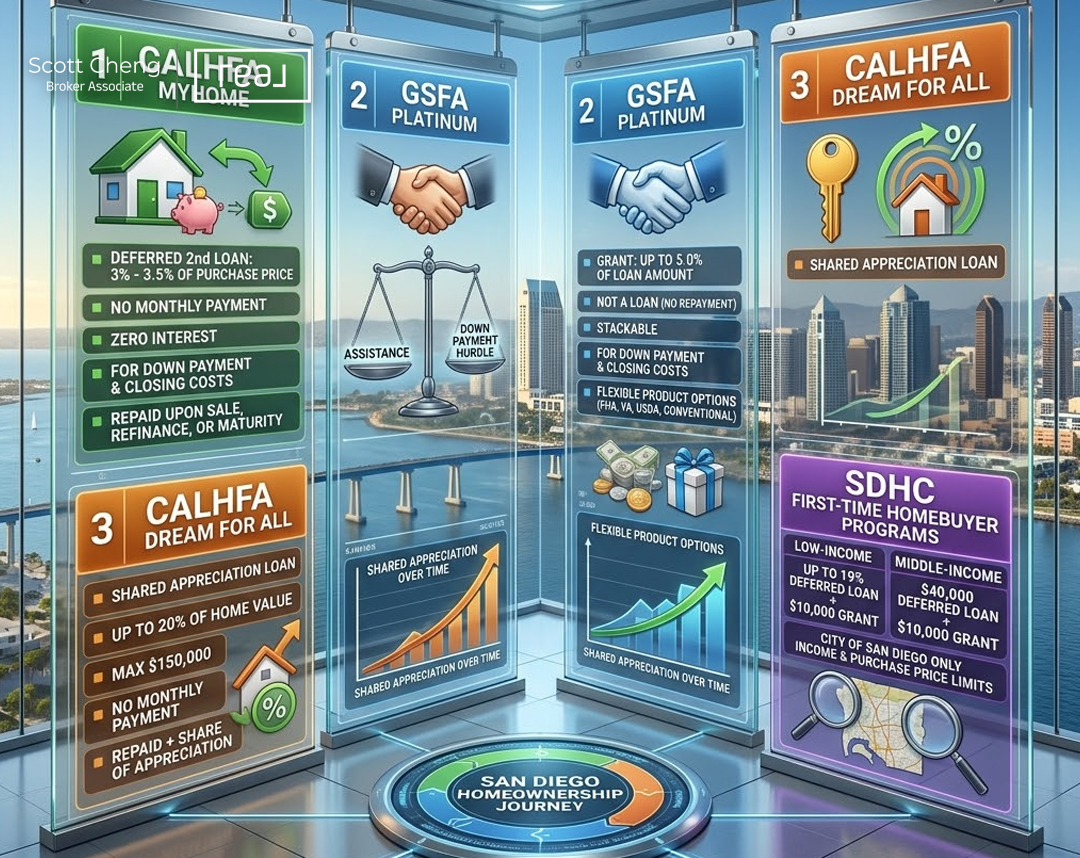
What Down Payment Assistance Programs Are Available in San Diego in 2026
You can tap San Diego city and county assistance, CalHFA deferred loans, and layered grants to cover part of your down payment and closing costs in 2026. Most programs target first-time buyers with income limits, education classes, and owner-occupancy rules.
Why does down payment assistance matter right now in San Diego?
Down payment assistance matters right now because San Diego affordability is tight but improving, and the right program can turn 2026 market conditions into your purchase year. Mortgage rates are expected to average about 6.1% in 2026 as forecasts call for sales to rise and median prices to grow around 4%. Detached home prices sit near $1,089,795, while condos and townhomes are a more attainable entry at a $660,000 median. Inventory for detached homes is still lean with months of supply down, and buyers continue to favor move-in ready listings. The good news is that a $3,000 monthly budget buys roughly $25,000 more home than last year as rates ease. Down payment assistance can be the lever that turns today’s improving conditions into a purchase this year instead of next. If you understand which San Diego programs you can stack and how they affect your payment, you can compete for the right home without waiting for a mythical market reset.
What do you need to know before applying for down payment assistance in San Diego?
Before applying, you need to understand how San Diego down payment assistance actually works and what eligibility rules apply to your situation. Most options provide a second loan or grant that helps with the down payment and sometimes closing costs. Many are deferred, meaning no monthly payment until you sell, refinance, or pay off the home. Others are shared appreciation, where you repay a percentage of future equity.
Key points for San Diego in 2026:
- First-time buyer status usually means you have not owned a home in the past three years.
- Income caps are tied to San Diego area median income and household size. Many programs target up to 80% of AMI, while some reach higher bands with different terms.
- Price and loan limits apply and can affect how far your assistance goes with San Diego prices.
- Most programs require a HUD-approved homebuyer education class before closing.
- Funding windows open and close. You need to confirm availability early with a lender approved for the specific program.
- You can often layer a city or county program with a state program like CalHFA, and sometimes with employer or union benefits, but stacking rules vary.
With a $660,000 condo median, 3% assistance can cover a typical minimum down payment on many conventional or FHA structures. On a $1,089,795 detached home, assistance may help but caps can limit feasibility, which is why many first-time buyers prioritize attached homes in San Diego.
What types of down payment assistance programs exist in San Diego?
- Deferred-payment second loans: No monthly payments until a maturity event. Often used for down payment and closing costs.
- Forgivable loans or grants: Balance may be forgiven after living in the home for a set period if you meet conditions.
- Shared appreciation loans: Larger help up front in exchange for a share of future appreciation when you sell or refinance.
- Mortgage credit certificates when available: Provide potential federal tax credits that can offset interest, improving qualifying power.
How do you compare down payment assistance options in San Diego?
Comparing options means matching your income, timeline, and long-term equity goals to the specific structure of each program. Rate relief in 2026 helps, but the structure of assistance has a bigger impact on your long-term equity and flexibility.
Consider these pros and cons:
- Grants and forgivable loans — Pros: No repayment after conditions are met, lower debt load. Cons: Smaller dollar amounts, strict occupancy or affordability rules, limited funding windows.
- Deferred-payment seconds — Pros: No monthly payment, can bridge the entire minimum down payment, helps you buy sooner. Cons: Must be repaid when you sell or refinance, can reduce net proceeds later.
- Shared appreciation loans — Pros: Highest assistance amounts, improves affordability at higher price points. Cons: You share equity gains, which can feel expensive in appreciating San Diego markets.
Key factors to evaluate:
- Eligibility: Your income relative to San Diego AMI, first-time status, credit score, and debt-to-income ratio.
- Price and loan caps: Whether the home you want fits assistance limits given San Diego’s $660,000 attached median and $1,089,795 detached median.
- Total monthly payment: Assistance may change your first mortgage rate and mortgage insurance structure.
- Long-run cost: Shared appreciation and deferred payback affect future equity. Model both a five-year and ten-year scenario.
- Timelines and funding certainty: San Diego programs can be competitive. Ask your lender to confirm allocations before you write offers.
How do you apply for down payment assistance in San Diego step by step?
Applying for down payment assistance in San Diego follows eight clear steps from prequalification through closing. Follow this process to avoid delays and maximize your assistance.
1) Get prequalified with a lender authorized for San Diego city or county assistance and state programs like CalHFA. Confirm they can layer programs if that is part of your plan.
2) Check eligibility against San Diego AMI income caps, price limits, and first-time buyer rules. Have documentation ready for household income, assets, and residency.
3) Complete a HUD-approved homebuyer education class. Many San Diego programs require a certificate before loan documents.
4) Choose the right first mortgage. Conventional, FHA, and sometimes VA for eligible service members can pair with assistance. Compare rate, mortgage insurance, and debt-to-income impacts.
5) Select the assistance structure. Decide between a grant or forgivable loan for minimal future obligations, a deferred-payment second for flexibility now, or a shared appreciation loan for larger help at the cost of future equity.
6) Optimize your offer strategy for San Diego. Ask your lender to include program timelines in your preapproval letter, and work with your agent to request seller credits where appropriate to cover closing costs or a temporary buydown.
7) Clear underwriting conditions early. Assistance programs add documents and approvals. Stay ahead on items like appraisal, condo questionnaires, and homeowner’s insurance.
8) Final approval and closing. Confirm the assistance funds are reserved, closing disclosures are accurate, and post-closing conditions such as occupancy affidavits are signed.
What does down payment assistance look like at real San Diego price points?
At a $660,000 condo median with 3% down, assistance can cover the full $19,800 minimum down payment, making it a practical path for most first-time San Diego buyers. Condos and townhomes carry a median of about $660,000, which is where many first-time buyers focus due to affordability and lower maintenance. A deferred second or grant can cover that amount, and you might still need to plan for closing costs, which often run 2% to 3% of the price. With a supportive seller credit or lender credit, you can reduce out-of-pocket funds further, and sometimes apply credits to interest-rate buydowns to get closer to your $3,000 budget.
For detached homes near the $1,089,795 median, program caps and qualifying limits often narrow the field. Assistance can still be valuable to bridge a partial down payment or closing costs, but many first-time buyers in San Diego find better fit and negotiating room in the attached segment. Days on market average around 57, which gives you space to complete assistance approvals, but move-in ready homes still draw competition. As mortgage rates average near 6.1% in 2026, you regain buying power compared to last year, and forecasts point to moderate price growth. That supports acting when a well-priced home aligns with program rules rather than waiting for a larger correction.
What do most buyers get wrong about down payment assistance in San Diego?
Most buyers wrongly assume they need 20% down, that assistance is only for very low incomes, or that condos are ineligible — all three assumptions can cost you a real opportunity. Many successful first-time buyers close with 3% to 5% down supported by assistance and negotiated credits. In reality, some programs serve buyers above 80% of AMI with different terms. Buyers also underestimate the timeline. Assistance adds steps and separate approvals, so you should start documentation and homebuyer education early. Eligibility for condos is common if the building meets lender and program requirements. The best path is to confirm funding windows, caps, and stacking rules upfront so your offer strategy matches the realities of San Diego’s market.
Frequently Asked Questions for San Diego Buyers
Which San Diego programs should you look at first?
Start with city or county assistance that offers deferred second loans or grants for down payment and closing costs. Pair those with state options like CalHFA if you qualify. Confirm income limits, price caps, and funding availability because San Diego allocations can be competitive.
Can you combine San Diego assistance with CalHFA?
Often yes. Many buyers layer a San Diego program with a CalHFA deferred loan if both allow stacking. You must use a lender approved for each program and meet all guidelines. Stacking can cover the entire minimum down and much of the closing costs when structured correctly.
Do you have to be below 80% of AMI to qualify for San Diego down payment assistance?
Not always. Some assistance targets up to 80% of AMI, but others extend to higher income tiers with different terms. Your eligibility depends on household size, first-time status, credit, and price caps. Ask your lender to run scenarios across multiple San Diego programs.
Are grants available in San Diego or only loans?
Both exist. Grants or forgivable loans reduce what you owe after meeting occupancy and time requirements. Deferred-payment seconds require repayment at sale or refinance. Shared appreciation options provide larger help in exchange for a portion of future equity.
Can you use down payment assistance to buy a condo in San Diego?
Yes, if the condo project meets lender and program standards. Many first-time buyers in San Diego use assistance for condos because the $660,000 median aligns better with program limits. Your lender will review the HOA budget, insurance, and project approvals.
How much down payment help can you expect in San Diego?
Amounts vary. Smaller grants may cover part of closing costs, while deferred or shared appreciation loans can cover 3% to 20% of the price, subject to caps. The exact figure depends on your income, the loan type, and San Diego program guidelines in effect when you apply.
Will using down payment assistance delay your closing in San Diego?
It can add time. Program approvals, homebuyer education certificates, and extra underwriting steps create more milestones. Start early and choose a lender who routinely funds San Diego assistance. Build a timeline into your offer so sellers understand the process.
Does down payment assistance affect your interest rate in San Diego?
Sometimes. Certain structures pair with specific first mortgage products that have set rates. Others let you choose from market rates. A lender can show how assistance, mortgage insurance, and potential buydowns change your total monthly payment and cash to close.
Can you use seller credits with San Diego down payment assistance?
Often yes. Seller credits can cover closing costs or fund a temporary rate buydown, reducing your monthly payment. Some programs cap total credits or require your minimum borrower contribution. Your lender and agent should structure credits within San Diego program limits.
Is 2026 a good year to use down payment assistance in San Diego?
Yes if your budget, eligibility, and a suitable home align. Rates near 6.1%, improving buying power, and forecasted 4% price growth argue for acting when the right San Diego property hits the market. Assistance can bridge the gap without waiting for a broader price drop.
The Bottom Line
You have real options to close the gap between savings and San Diego prices in 2026. City and county programs, CalHFA deferred loans, and layered grants can cover down payment and closing costs if you meet income, price, and education requirements. With condos and townhomes at a $660,000 median and rates near 6.1%, assistance can convert today’s improving affordability into a purchase this year. The key is pairing the right program type to your timeline and long-term goals, then structuring your offer with realistic funding and closing steps. When you evaluate total cost and equity trade-offs up front, you can move confidently on the right San Diego home.
If you’re ready to explore your options for down payment assistance in San Diego, Scott Cheng at Scott Cheng — REAL Brokerage can walk you through the specifics for your situation.
858-405-0002 | DRE #01509668 | 16516 Bernardo Center Dr. Ste. 300, San Diego, CA 92128
Have Questions About San Diego Real Estate?
Scott Cheng provides free, no-obligation consultations for buyers, sellers, and investors.
Schedule a Consultation