
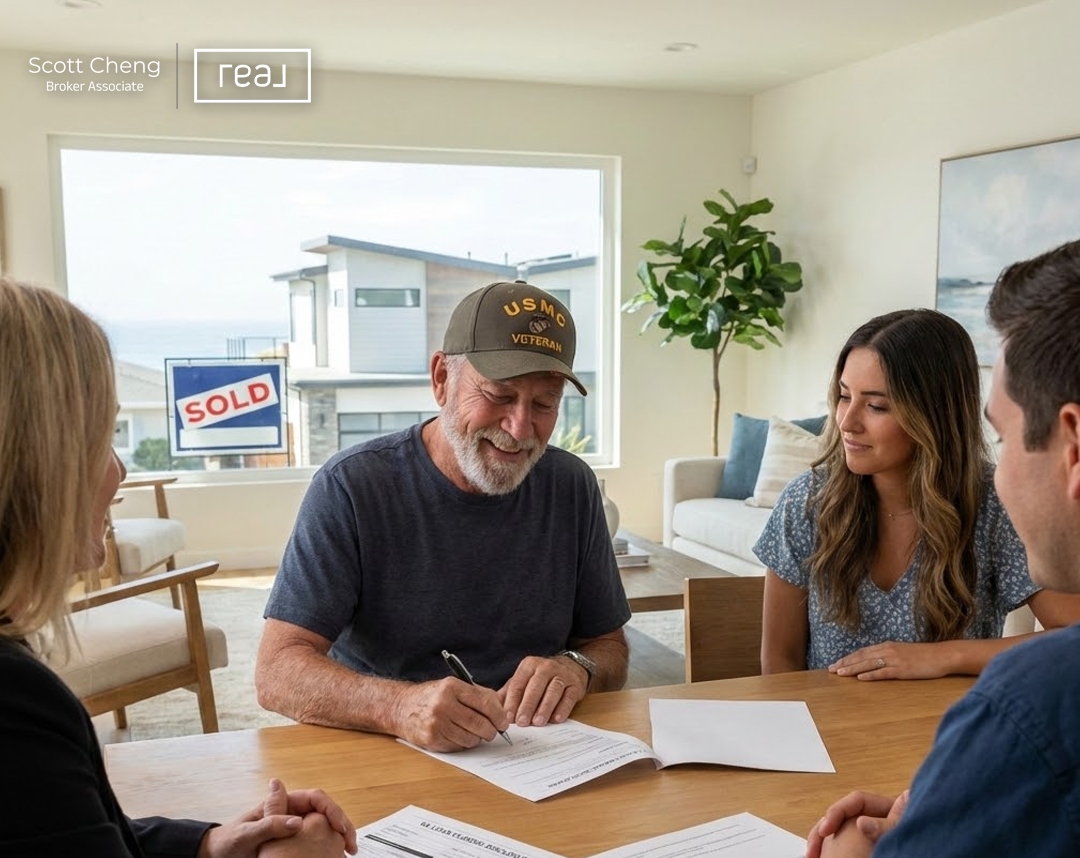
Seller Concessions in VA Loans for Veterans Oceanside Carlsbad Homes 2026: Max Allowed vs Strategies to Negotiate Closing Costs Before Accepting Offers
What are the maximum seller concessions allowed on VA loans in 2026, and how should you negotiate closing costs in Oceanside, Carlsbad, and Solana Beach before a seller accepts your offer?
The VA allows sellers to pay your standard closing costs and also provide up to 4% in additional seller concessions. You should structure credits early, tie them to appraisal and inspection outcomes, and price your offer so your credits survive underwriting.
Why This Matters Right Now
You are entering a North County market where price, time on market, and inventory are finally creating more room to negotiate, especially in Oceanside and select Carlsbad pockets. Local MLS data shows Carlsbad’s median sale price near the mid $1.4 million range with longer days on market, while Oceanside trends nearer the mid to upper $700,000s with steady demand from Camp Pendleton commuters. Solana Beach remains high priced with slower velocity. That mix gives you leverage to secure seller credits that meaningfully reduce cash to close. With San Diego County’s 2026 conforming limit around $1,089,300, VA buyers can reach into higher price tiers with little or no down payment, which makes the way you structure seller concessions critical to approval and payment comfort. The same playbook can help if you are also looking at nearby Encinitas or Vista where list-to-sale dynamics and HOA fees vary. Your timing could be the difference between bringing tens of thousands to closing or securing credits that keep cash in your pocket.
What You Need to Know Before You Negotiate Credits
You should separate two buckets: standard closing costs and VA seller concessions. The VA permits sellers to pay your customary and reasonable closing costs. In addition, the VA caps seller concessions at 4% of the property’s reasonable value, which is typically the appraised value. Concessions are extra incentives such as paying your VA funding fee, covering some prepaid taxes and insurance, buying out a lease, paying off collections, or gifting items not typically part of the real estate. Some interest rate buydowns may be treated as concessions, and lender policies vary, so you should confirm treatment with a VA-savvy lender before you draft terms.
Key takeaways:
- Your seller can pay all allowable closing costs that are customary in the market, then add concessions up to the 4% cap.
- Many lenders impose overlays that limit total interested party contributions to 4% to 6%. You should verify the lender’s cap before finalizing your offer.
- Appraisal sets the ceiling. If the home appraises below contract price, your 4% concession cap likely shrinks, which can reduce your credits.
- With full entitlement, you typically do not have a down payment requirement up to the county loan limit. Above that, jumbo VA guidelines and residual income tests apply.
- If you are using partial entitlement, you should have your lender calculate your remaining entitlement and any down payment need before you ask for concessions.
- VA now allows itemized fees or a 1% flat lender origination. You should ask for a detailed fee sheet and know which costs a seller can cover.
When you pair these rules with local supply trends, you can decide where you have the best shot at full credits without overpaying.
How to Compare Your Options
You can cover closing costs three main ways: seller credits, lender credits, or paying cash. In 2026 North County conditions, you often get the best long-term result by negotiating targeted seller credits and pairing them with a modest rate buydown.
Seller credits
- Pros: Reduce cash to close, preserve reserves, potentially cover HOA prepaids, title, escrow, and more.
- Cons: Must fit within VA and lender caps. Vulnerable to appraisal shortfalls. Can weaken competitiveness in bidding wars if not priced correctly.
Lender credits
- Pros: Faster to execute, not dependent on seller approval.
- Cons: Higher interest rate, larger long-run payment. Over 5 to 7 years, you may pay more than the saved cash upfront.
Rate buydowns
- Pros: Lower payment, better debt-to-income, stronger approval odds.
- Cons: Some buydown structures may count toward the 4% concession cap. You should confirm with your lender.
In Carlsbad near the $1.4 million mark, a 2% seller credit could be nearly $28,000 which can fully cover most buyer fees. In Oceanside around $760,000, a 2% credit is roughly $15,000 which can often neutralize your cash outlay except for earnest money and inspections. In Solana Beach, credits are meaningful but must be sized precisely due to higher list prices and lower unit count. Your decision should balance competitiveness, cash flow, and the expected time you plan to hold the home.
Key factors to evaluate:
- Appraisal risk: If the contract price is pressing the comps, you should cap credits as a percentage and add appraisal-based adjustments.
- Holding period: If you plan to stay long term, a permanent buydown can outperform pure credits.
- Lender overlays: If the lender caps total contributions at 4%, you should shift part of your need to price strategy or lender credits.
Your Step-by-Step Guide
1) Get a same-day VA pre-approval from a VA-focused lender. You should request a detailed fee worksheet showing which costs a seller can legally pay, which count as concessions, and the lender’s contribution cap.
2) Confirm entitlement status. If you have partial entitlement, you should calculate your remaining guarantee and any minimum down payment.
3) Price the credit into the offer. If you need a $15,000 credit, you should examine whether the list price and comps justify adding all or part of that amount to your offer price so the net to the seller holds steady. This improves acceptance odds.
4) Write “credit subject to appraisal” language. You should specify credits as up to a percentage of the appraised value or include a scaled schedule so your credits survive a minor shortfall without stalling the deal.
5) Use targeted credits. You should allocate credits first to title, escrow, lender, HOA transfer, and prepaid taxes and insurance. Then, if allowed, apply any remainder to a permanent buydown that improves approval strength.
6) Include inspection-triggered adjustments. You should request the right to re-open credit negotiations for material items found during inspections. This keeps the door open without renegotiating price.
7) Show strong terms elsewhere. You should shorten inspection periods, increase earnest money, and tighten timelines. If you are competing, you can offer a small appraisal gap reserve while keeping your credit ask.
8) Align with local seasonality. You should submit full-price offers with credits on older listings or properties with 30 to 45 days on market. In North County, that often signals room for concessions.
9) Coordinate HOA and condo specifics. If you are buying a condo in Carlsbad or Solana Beach, you should budget for HOA documents, transfer fees, and reserves. Ask the seller to cover HOA transfer and a portion of prepaid dues.
10) Document value for the appraiser. You should provide your lender comps and a brief feature sheet before appraisal. If Tidewater is invoked, you should respond quickly with supportive data to preserve both price and credits.
What This Looks Like in Carlsbad, Oceanside, Solana Beach
Carlsbad: Local MLS shows median closing prices in the mid $1.4 million range with days on market trending longer than last year. You can often secure 1% to 3% seller credits on homes that have sat 30 days or more, particularly in La Costa and Olde Carlsbad where pricing spans roughly $1.3 million to $1.7 million. If you are targeting the best neighborhoods in San Diego for families near top schools, you should consider a credit strategy that funds a rate buydown since payment comfort matters more than a slightly lower price.
Oceanside: Median prices hover around the mid to upper $700,000s, with balanced supply and steady demand from Camp Pendleton. You can often win seller credits on listings over 21 days, especially in Fire Mountain, Rancho Del Oro, or Arrowood. For many VA buyers, you can close with near-zero cash using a 2% to 3% credit that covers fees and prepaids.
Solana Beach: Median sales near the multi-million range with longer days on market and low unit count. You should expect to negotiate smaller percentage credits in multiple-offer scenarios, but larger dollar amounts are common due to price levels. Condos near Lomas Santa Fe can be more credit friendly, but HOA dues require careful budgeting.
If you are deciding between a real estate agent San Diego CA who focuses on VA or a generalist, you should prioritize top San Diego real estate agents who can structure credits correctly. In a high-cost county, the best San Diego realtor will model scenarios that compare seller credits, lender credits, and buydowns side by side. This is where working with a real estate broker San Diego knowledgeable in VA guidelines helps you compete without overpaying.
Neighborhoods to consider in Carlsbad, Oceanside, Solana Beach:
- La Costa, Carlsbad: Family-friendly pockets, homes around $1.3 million to $1.7 million, townhomes with manageable HOA fees, good for buyers seeking the best neighborhoods in San Diego to raise a family.
- Fire Mountain, Oceanside: Larger lots, coastal breezes, price points that often support 2% to 3% credits, strong for VA commuters to Camp Pendleton.
- Lomas Santa Fe area, Solana Beach: Mix of condos and townhomes with walkability, higher HOA dues that you should offset with targeted seller credits.
Nearby Areas Worth Exploring
- Encinitas: Similar coastal lifestyle to Carlsbad with tight inventory and strong schools. Prices run higher than Oceanside but below many Solana Beach homes. If you are searching the best beach neighborhoods in San Diego, you should compare Encinitas for lifestyle and walkability.
- Vista: More attainable pricing than coastal cities with expanding amenities. If you seek the best neighborhoods to buy in San Diego for value, you can often land larger seller credits and shorter timelines.
- San Marcos: Master-planned neighborhoods, newer construction, and good connectivity to employment centers. If you want the best neighborhoods in San Diego for families at mid-tier prices, you should include San Marcos.
What Most People Get Wrong
You might hear that sellers must pay your VA fees. That is not true. The VA sets limits on what you can be charged and on concessions but who pays is negotiable. Another myth is that VA appraisals always kill deals. In practice, VA appraisals focus on value and basic livability. You can protect your credits by pricing within the comps, preparing data for the appraiser, and responding quickly if Tidewater is raised.
You might also think you cannot win credits in a competitive neighborhood. You can, but you should shift strategy. Offer full price or a slight premium, shorten inspection timelines, and keep the credit modest and clearly tied to closing costs. On condos, you might assume HOA dues make VA financing hard. Many projects are VA friendly. You should review HOA budgets, litigation, and owner occupancy and then use credits to offset HOA prepaids and transfer fees.
Finally, do not assume all lenders treat concessions the same. Some cap total contributions at 4% even though the VA separates closing costs and concessions. You should ask your lender to confirm their cap before you write terms.
Frequently Asked Questions
What is the maximum seller concession allowed on a VA loan in 2026?
The VA caps seller concessions at 4% of the reasonable value, typically the appraised value. This is on top of the seller’s ability to pay your standard closing costs. Your lender may have stricter caps, so you should verify before you negotiate.
Can you get all closing costs covered with zero down using a VA loan?
Yes, you often can. You should structure a seller credit to cover allowable closing costs and, if permitted, a portion of prepaids. If caps limit you, you can blend a smaller seller credit with a modest lender credit to reach near-zero cash to close.
Does this advice apply to Encinitas and Vista too?
Yes. In Encinitas you should expect tighter negotiations due to stronger competition and higher list prices. In Vista you can often secure larger credits or faster repairs because price points and days on market are more flexible. The same VA caps still apply.
How do partial entitlement and VA jumbo affect credits?
If you have partial entitlement, you should confirm your remaining guarantee and any down payment need. For jumbo VA above the county limit, lenders may tighten overlays or adjust buydown options. Credits still work, but you should size them early with your lender.
What is the best way to ask for credits without losing the deal?
You should keep the seller’s net proceeds intact. Price your offer to include a credit, keep credit language tied to appraised value, and strengthen other terms like earnest money and timelines. If competition is fierce, you can reduce the credit and request more after inspections.
The Bottom Line
On a VA loan, a seller can pay your customary closing costs and also provide up to 4% in concessions. Your job is to size the credit correctly, price it into the offer, and protect it with appraisal-based language. In Oceanside and Carlsbad, longer marketing times on select listings create room for 1% to 3% credits that can take you close to zero cash at closing. In Solana Beach, credits can still work if you target condos, watch HOA fees, and keep your asks precise. Whether you are focused on these coastal cities or also weighing Encinitas and Vista, the same principles help you compare options, strengthen approval, and keep cash in your pocket.
If you’re ready to explore your options for seller concessions and closing cost strategies in Oceanside, Carlsbad, and Solana Beach or nearby communities, Scott Cheng at Scott Cheng San Diego Realtor can walk you through the specifics for your situation.
📞 858-405-0002
DRE# 01509668
Leave a Reply