

Is Midway District San Diego a Good Neighborhood for First-Time Buyers in 2026?
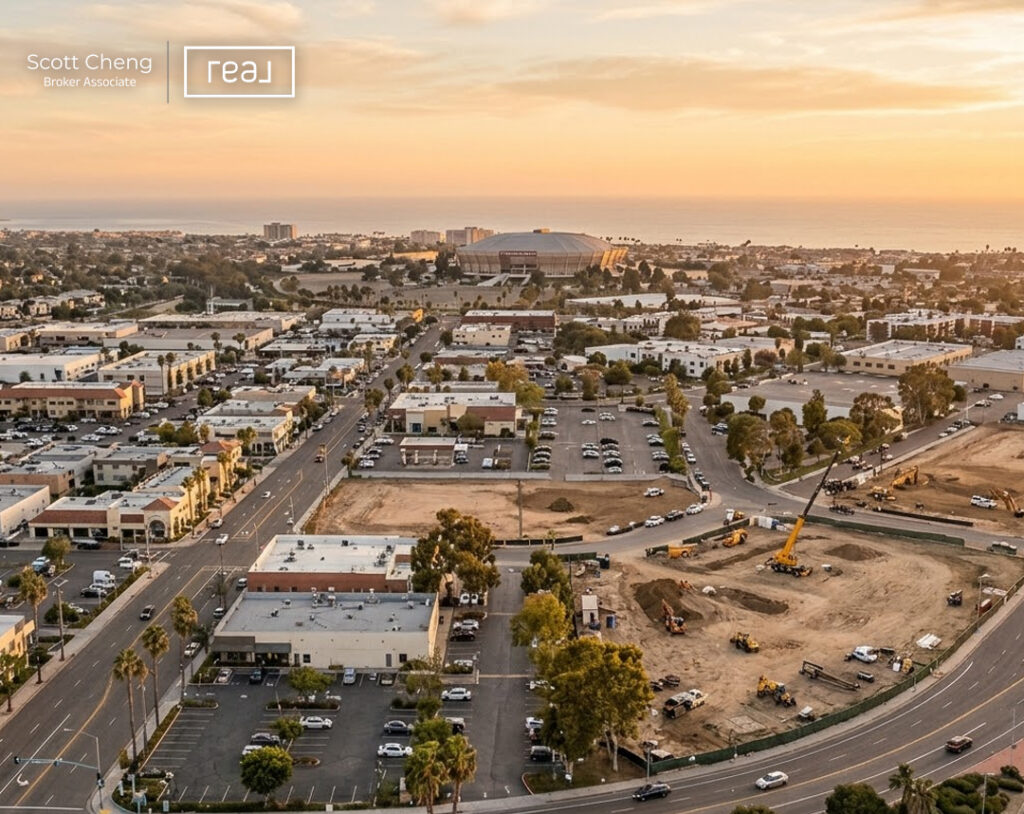
Is the Midway District in San Diego worth the risk for first-time home buyers in 2026, or should you wait until the massive redevelopment is further along?
[SNIPPET ANSWER: Midway District offers real upside for first-time buyers willing to accept short-term uncertainty, but the ongoing legal challenges around the 30-foot height limit mean the timeline for transformation remains unpredictable.]
Why the Midway District Conversation Matters Right Now in San Diego
If you’ve been researching the best neighborhoods in San Diego for first-time buyers, Midway District has probably caught your attention. A $3.9 billion redevelopment. Thousands of new apartments. A brand-new arena. Parks, shops, bike paths. It sounds like the kind of neighborhood that could deliver serious long-term value.
But here’s where it gets complicated. The project, known as Midway Rising, has been approved by the San Diego Planning Board, yet it still faces a legal challenge over a 1972 voter-approved 30-foot height limit. Courts have overturned voter exemptions twice, and the case is now headed to the California Supreme Court.
So where does that leave you as a first-time buyer? I’ve spent 16 years helping buyers navigate exactly these kinds of decisions across San Diego County. Let me walk you through what I’d tell you if we were sitting across from each other right now, because a cloudy mind can’t make decisions, and this one deserves clarity.
What the Midway Rising Redevelopment Actually Means for San Diego Buyers
Let me give you the full picture before you form an opinion. Midway Rising is planned as 4,254 new apartments on 49 acres of city-owned land, with nearly half designated as affordable housing. It would include 130,000 square feet of shops and restaurants, 14 acres of public space, a new 16,000-seat arena, and major infrastructure improvements.
According to city economic development officials, the annual economic impact could rival what Comic-Con brings to San Diego. That is not a small claim.
What does that actually mean for your wallet? If the project moves forward on schedule, with ground-breaking targeted for late 2026, properties purchased in the surrounding Midway area before construction begins could appreciate significantly as the neighborhood transforms. This is the classic “buy before the catalyst” opportunity that investors and savvy first-time buyers look for.
But, and this is a big “but,” the timeline hinges on legal outcomes that are genuinely uncertain.
The Legal Risk You Need to Understand Before Buying in Midway District
Here’s the part I want you to really absorb. San Diego voters approved removing the 30-foot height limit in the Midway District twice, in 2020 and again in 2022. Both times, a local group called Save Our Access successfully challenged the vote in court, arguing the city hadn’t completed adequate environmental impact analysis.
The city is now appealing to the California Supreme Court. If the court rules in the city’s favor, the project moves forward. If it doesn’t, the developers would need to redesign buildings to comply with the height restriction, which changes the entire scope and economics.
There is a potential workaround. The developers argue the project qualifies under California’s state density bonus law because roughly 90% of the built space is residential. The approved community plan update already allows up to 10,155 new homes in the area regardless of the height limit outcome. What changes is the shape and density of the buildings, not necessarily the total housing count.
One couple I recently worked with was weighing a condo in Clairemont Mesa against a unit near the Midway area. We talked through this exact legal landscape. Ultimately, they decided the uncertainty didn’t match their comfort level for a first purchase, and we found them a great fit in Clairemont where they felt confident about the neighborhood trajectory. The right call depends entirely on your risk tolerance and timeline.
What Midway District Looks Like Today Versus What It Could Become
I want to be honest with you about the current state of the neighborhood, because any real estate agent in San Diego who glosses over this isn’t doing their job. Today, the Midway District is anchored by Pechanga Arena, surrounded by aging commercial strips, big-box retail, and surface parking lots. It is not a walkable, charming neighborhood. The area was built up around military housing after World War II, and the infrastructure reflects that era.
That said, the community plan update is already in place. New zoning allows for significant residential development even without the height limit exemption. Smaller projects and infill housing can proceed under current rules, which means incremental change is happening regardless of the Midway Rising outcome.
For a first-time buyer, the question is this: are you comfortable living through the “before” phase of a neighborhood transformation, knowing the “after” could take five to ten years to fully materialize?
Having closed over 275 transactions across San Diego, I’ve seen this pattern in other neighborhoods. Buyers who purchased early in redevelopment corridors and held for five-plus years generally came out ahead, but the experience during that holding period matters too. You have to actually enjoy where you live.
How Midway District Pricing Compares for First-Time San Diego Buyers
San Diego’s median home price has climbed to $1,074,000 for single-family homes as of April 2026, a 5.8% year-over-year increase. For most first-time buyers, the realistic entry point is the condo and townhome segment, where the county-wide median sits at $670,000, actually down 1.1% year over year, giving buyers a bit more negotiating room.
The Midway District currently offers some of the more accessible price points in central San Diego because the neighborhood hasn’t yet undergone its transformation. You’re not paying a premium for what the area will become; you’re paying for what it is today.
Here’s why that matters. Only 13% of San Diego County households can afford a median-priced home. If you’re a first-time buyer earning between 80% and 150% of the area median income, you may qualify for the SDHC Middle-Income Program down payment assistance, which provides a $40,000 deferred down-payment assistance loan and a $10,000 closing costs grant. At Midway’s current price points, that kind of assistance stretches further than it would in Carmel Valley or Scripps Ranch.
Another buyer I worked with, a young professional relocating for a biotech position, initially wanted to be in a fully established neighborhood. After we ran the numbers together, he realized that buying into a transitioning area near Midway and using down-payment assistance gave him a monthly payment he could actually live with. Three years later, he refinanced into a lower rate and his equity position was stronger than projected.
What I Tell First-Time Buyers About Redevelopment Risk in San Diego
Risk is not a reason to avoid a purchase. Unexamined risk is. Here’s the framework I use with my clients when evaluating a neighborhood in transition:
- Your timeline matters most. If you plan to stay five-plus years, you can weather short-term uncertainty. If you might need to sell in two to three years, a neighborhood mid-transformation adds unpredictability to your exit strategy.
- Separate the project from the location. Even if Midway Rising faces further delays, the Midway District still benefits from its central location between Point Loma, Ocean Beach, and Mission Bay. Geography doesn’t change.
- Look at what’s already approved. The community plan update allows over 10,000 new homes under existing zoning. The redevelopment is a catalyst, not the only path forward.
- Understand your financing. San Diego’s conforming loan limit is $1,104,000 for 2026. Most Midway purchases will fall well within conventional loan territory, which keeps your financing options flexible. If you’re VA-eligible, zero down payment and no mortgage insurance makes the math even more favorable.
- Don’t underestimate the affordable housing pipeline. With 2,000 of the planned units designated as affordable for households earning up to $132,400 for a family of four, the project is designed to bring long-term residents, not just investors.
As an Associate Broker with 180 five-star reviews from past clients, I take risk assessment seriously. One thing I always tell people: my job is to bring you clean information and realistic options so you can make a decision you feel good about, not one that keeps you up at night.
Frequently Asked Questions About Buying in Midway District San Diego
Is Midway District San Diego safe for first-time buyers right now?
The area is safe for transactions, but you should visit at different times of day to get a feel for the neighborhood. Current conditions reflect an aging commercial district, not a residential enclave. Safety will likely improve significantly as residential density increases through planned development.
When will Midway Rising construction actually begin in San Diego?
Developers have stated the soonest ground-breaking would be late 2026, but this depends on the California Supreme Court ruling regarding the 30-foot height limit. If the appeal fails, significant redesign could push timelines further out by a year or more.
What happens if the Midway Rising project gets cancelled?
The community plan update has already been approved, allowing up to 10,155 new homes under existing zoning. Even without Midway Rising, the area is positioned for gradual residential growth, though the pace and scale would be considerably smaller.
Can I use down-payment assistance to buy in the Midway District?
Yes. The SDHC First-Time Homebuyer programs cover purchases within the City of San Diego, including Midway. The Middle-Income Program offers a $40,000 deferred loan plus a $10,000 closing cost grant for buyers earning between 80% and 150% of the area median income.
How does the 30-foot height limit affect my purchase in Midway District?
The height limit primarily affects new large-scale construction, not your individual purchase of an existing property. However, it determines whether the full Midway Rising vision can be built as designed, which impacts the neighborhood’s long-term trajectory.
Are there condos available for first-time buyers in Midway District San Diego?
Current inventory is limited but present, and price points in the area tend to fall below the county-wide condo median of $670,000. This makes Midway one of the more accessible central San Diego locations for first-time condo buyers.
Will property values go up in Midway District San Diego?
If the redevelopment proceeds, significant appreciation is likely over a five-to-ten-year horizon. Even without the full project, the central location and zoning changes support gradual value growth. No outcome is guaranteed, but the fundamentals are favorable.
What are the best financing options for buying in Midway District?
Conventional loans with as little as 3% to 5% down work well at Midway’s price points. FHA loans versus conventional financing are options to compare, though FHA carries permanent mortgage insurance at San Diego prices. VA loans are ideal for eligible buyers, offering zero down and no mortgage insurance.
How does Midway District compare to other San Diego first-time buyer neighborhoods?
Midway offers lower entry prices than established neighborhoods like North Park or Hillcrest, with higher upside potential but more uncertainty. Neighborhoods like Clairemont Mesa or Mira Mesa offer more stability with proven residential infrastructure already in place.
Should I wait until after the Supreme Court ruling to buy in Midway District?
Waiting gives you certainty but potentially higher prices if the ruling is favorable. Buying now gives you current pricing with acceptance of timeline uncertainty. Your decision should align with your financial cushion and how long you plan to stay in San Diego.
The Bottom Line on Buying in Midway District San Diego
The Midway District is not a slam-dunk and it is not a trap. It is a calculated opportunity with genuine upside and real uncertainty. If you’re a first-time buyer with a five-year-plus horizon, stable income, and comfort with a neighborhood that hasn’t yet become what it’s going to be, Midway deserves serious consideration.
If you want the certainty of established neighborhoods, trees, and walkable cafes on day one, you’ll likely find a better fit elsewhere in San Diego.
Either way, the decision is yours, and it should feel clear when you make it. If you’d like to talk through the numbers for your specific situation, I’m Scott Cheng, Associate Broker with Real Brokerage, and I’m at 858-405-0002. I’d be glad to help you sort through your options and find the right neighborhood for your first home in San Diego.