How Much It Costs to Buy a Home in San Diego as a First-Time Buyer in 2026
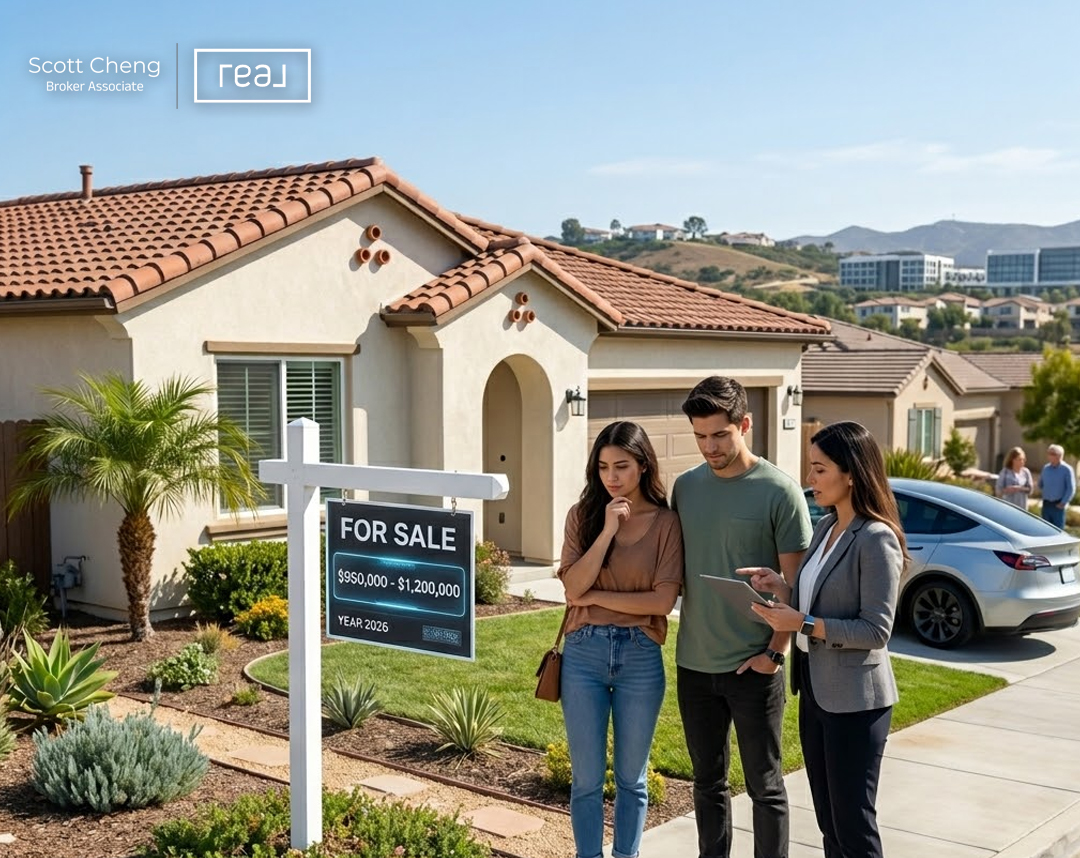
What does it actually cost a first-time buyer to purchase a home in San Diego in 2026, and how can you plan for every expense?
In 2026, first-time San Diego buyers can expect total upfront costs between $30,000 and $175,000 depending on property type, neighborhood, and loan program, with condos near $660,000 offering the most accessible entry point.
Why San Diego Housing Costs Matter for First-Time Buyers Right Now
Here’s what I want you to understand about the San Diego market this year: it’s recalibrating. Not crashing, not booming, just finding a new rhythm. And that rhythm is actually creating some room for first-time buyers that hasn’t existed since before the pandemic.
Mortgage rates have come down from their 2025 highs, with the 30-year fixed averaging around 6.05% in February 2026 (down from 6.84% a year earlier). Inventory has expanded to roughly 2.2 to 3.0 months of supply depending on property type. Homes are sitting on the market for 32 to 43 days instead of the frantic 19-day scramble we saw in 2022.
Does that mean it’s easy? No. San Diego homebuyers faced a median down payment of $169,000 in late 2024, nearly three times the national median. According to Freddie Mac’s research on the decline in relative housing affordability, the gap between incomes and home prices has made first-time buying particularly challenging in high-cost metros like San Diego. But with the right strategy, the right loan product, and clear numbers in front of you, the picture becomes much less intimidating. A cloudy mind can’t make decisions, so let’s clear things up.
What San Diego Homes Actually Cost by Neighborhood and Property Type
Let me lay out the real numbers. The county-wide medians as of early 2026 look like this:
- Single-family homes (San Diego County): approximately $1,050,000
- Condos and townhomes (San Diego County): approximately $660,000
- Price per square foot: roughly $682 to $727
But those county-wide numbers mask a huge range depending on where you’re looking. In my 16 years of working with San Diego buyers, I’ve seen the neighborhood you choose change everything about your budget. For a deeper look at best San Diego neighborhoods for first-time home buyers in 2026, the right zip code can mean tens of thousands of dollars in savings.
North Park: Urban Walkability at a Premium
North Park‘s year-to-date median for single-family homes is $1,125,000. That’s above the county average and reflects the neighborhood’s Walk Score of 86, proximity to Balboa Park, and the cultural pull of 30th Street’s Brewery Mile. If you’re a young professional working downtown, that 15 to 20 minute bus ride on MTS Route 7 along University Avenue means you might not even need a second car.
But here’s the move most first-time buyers are making: North Park condos and townhomes carry a median of just $495,000, well below the county-wide condo median. Those units are moving fast (16 days on market), so you need to be ready to act.
Little Italy and East Village: Downtown Condo Entry Points
First-time buyers looking at condos in walkable neighborhoods like East Village or the Marina District represent one of the most active buyer segments I work with. Attached units downtown offer a realistic starting point, typically falling between $450,000 and $650,000 depending on the building, floor, and views.
Inland San Diego: More Space, More Value
Inland zip codes consistently offer larger floorplans at competitive prices. Many of the buyers I guide, especially those relocating for biotech or tech jobs, prioritize square footage and freeway access over ocean proximity. If you’re weighing your options, a comparison of Mira Mesa vs. Scripps Ranch for first-time buyers shows where your dollar stretches the furthest.
Every Dollar You Need: Down Payment, Closing Costs, and Hidden Expenses in San Diego
So what does the full picture look like? Let me walk through each piece.
Down Payment Scenarios for a $660,000 San Diego Condo
- VA Loan (0% down): $0 down payment (active military or veterans)
- Conventional Loan (3% down): approximately $19,800
- FHA Loan (3.5% down): approximately $23,100
- 10% down: approximately $66,000
- 20% down: approximately $132,000
Closing Costs
Expect closing costs of 2% to 5% of the purchase price. On a $660,000 condo, that’s roughly $13,200 to $33,000. The Consumer Financial Protection Bureau’s breakdown of all costs when buying a home is a useful reference for understanding what each line item covers, including lender fees, title insurance, escrow charges, prepaid property taxes, and homeowner’s insurance.
Ongoing Monthly Costs Beyond Your Mortgage
- Property taxes: approximately 1.1% of assessed value, which is roughly $605/month on a $660,000 purchase
- Homeowner’s insurance: varies, but budget $100 to $200/month
- HOA fees (condos/townhomes): typically $300 to $600/month
- Private Mortgage Insurance (PMI): required if you put down less than 20%, usually $150 to $300/month
One first-time buyer I worked with last spring was focused entirely on the down payment and almost forgot about HOA dues when calculating his monthly budget. We sat down, mapped out every recurring cost, and realized a different building two blocks away in North Park had HOA fees that were $175/month lower, saving him over $2,000 per year. That kind of detail matters.
San Diego First-Time Buyer Assistance Programs That Reduce Your Upfront Costs
This is where the math gets more interesting. Several programs exist specifically to help first-time buyers in San Diego, and I walk every qualifying client through them. For a comprehensive overview of down payment assistance programs for first-time buyers in San Diego, the options are more accessible than most buyers realize.
SDHC First-Time Homebuyer Low-Income Program
If you earn no more than 80% of San Diego’s Area Median Income, you may qualify for a deferred-payment second trust deed loan of up to 19% of the purchase price at a 3% interest rate, plus a closing cost assistance grant of up to $10,000. Since 1988, the San Diego Housing Commission has helped more than 6,100 families buy their first homes through programs like this. HUD’s resources on homeownership loan programs provide additional context on how federal and local assistance layers together for qualifying buyers.
SDHC First-Time Homebuyer Middle-Income Program
Earning between 80% and 150% of the Area Median Income? You may qualify for a $40,000 deferred down payment assistance loan and a $10,000 closing costs assistance grant. This one is a game-changer for young professionals in biotech, healthcare, or tech who earn solid incomes but haven’t had time to stockpile savings.
County of San Diego Down Payment and Closing Cost Assistance (DCCA)
For buyers with family incomes at or below 80% of the Area Median Income who haven’t owned a home in three years. You contribute a minimum of 3% of the purchase price, and there are no payments on the assistance loan until you refinance, sell, or move.
California Dream For All (CalHFA)
When available, this program offers up to 20% toward down payment or closing costs, capped at $150,000. It operates through a lottery-style voucher system (not first-come, first-served), and one borrower must be a first-generation homebuyer. The most recent application window closed in March 2026, but future rounds may open.
What I tell my clients: apply for everything you might qualify for, even if you’re not sure. Having closed over 275 transactions in San Diego, I’ve seen people leave tens of thousands of dollars on the table simply because they assumed they wouldn’t qualify.
How to Build Your San Diego Home Buying Budget: A Real-World Example
Let me walk you through a scenario I see regularly.
A couple relocating to San Diego for biotech jobs found a two-bedroom condo in North Park listed at $510,000. They had $25,000 saved. With an FHA loan at 3.5% down, their required down payment was $17,850. Closing costs came to about $15,300. Total cash needed: approximately $33,150.
They were $8,000 short. But after qualifying for the SDHC Middle-Income program’s $10,000 closing cost grant, they actually had a small buffer. Their monthly payment, including HOA, PMI, taxes, and insurance, landed around $4,100. To understand how much income you need to buy a home in San Diego, combined household income needed to stay within the 30% housing-cost rule: roughly $164,000 per year.
That’s the kind of clarity that turns “we can’t afford San Diego” into “here’s our plan.” With 180 five-star reviews from past clients, I can tell you the number one thing people say after going through this process is: “I wish I’d known the real numbers sooner.”
Best San Diego Neighborhoods for First-Time Buyers on a Budget
Homes priced under $700,000 face the most competition in San Diego right now, so knowing where to look is half the battle.
- North Park condos ($495,000 median): Walkable lifestyle near the Thursday Farmers Market on 30th Street, Kindred, Hamilton’s Tavern, and Balboa Park. You save on transportation costs with that 86 Walk Score.
- South Park: North Park’s quieter sibling. Single-family home prices were up 3.7% year-over-year in late 2025, with Craftsman charm and proximity to Balboa Park’s trails on Balboa Drive.
- East Village and Downtown condos: Ideal for young professionals who want an urban, walkable commute. Lower entry prices, though HOA fees tend to run higher in high-rise buildings.
- Inland neighborhoods: If you prioritize square footage and freeway access, these areas offer the strongest value per square foot compared to coastal neighborhoods.
Frequently Asked Questions About Buying a Home in San Diego in 2026
What is the minimum down payment to buy a home in San Diego?
The minimum down payment depends on your loan type. VA and USDA loans allow 0% down. Conventional loans start at 3% down, and FHA loans require 3.5%. Your credit score, income, and debt-to-income ratio will determine which programs you qualify for.
How much are closing costs for a San Diego home purchase?
Closing costs in San Diego typically run 2% to 5% of the purchase price. On a $660,000 condo, expect roughly $13,200 to $33,000 covering lender fees, title, escrow, prepaid taxes, and insurance. Several assistance programs offer grants to offset these costs.
What income do I need to buy a condo in North Park?
With a median condo price of $495,000 in North Park and a 20% down payment, your monthly payment runs roughly $3,500 to $4,000 including taxes, insurance, and HOA. Following the 30% rule, you’d need a household income of approximately $140,000 to $160,000.
Do first-time buyer assistance programs really help in San Diego?
Yes. The SDHC programs have helped over 6,100 families purchase their first homes since 1988. The Middle-Income program alone provides a $40,000 deferred down payment loan and a $10,000 closing cost grant. These programs are real and actively funded.
Can I buy a home in San Diego with less than $30,000 saved?
It’s possible, especially with a VA loan (0% down) or by combining a low-down-payment conventional or FHA loan with a closing cost assistance grant. A buyer with $25,000 saved can realistically purchase a condo in the $500,000 range using the right combination.
What are property taxes in San Diego County?
San Diego property taxes average approximately 1.1% of assessed value. On a $660,000 home, that’s roughly $7,260 per year, or about $605 per month. Your assessed value is based on the purchase price, not market fluctuations.
Is it cheaper to buy a condo or a house in San Diego?
Significantly cheaper to buy a condo. The county-wide median for condos is approximately $660,000 compared to $1,050,000 for single-family homes. However, condos carry monthly HOA fees of $300 to $600 that you won’t have with a house.
How competitive is the San Diego market for first-time buyers in 2026?
The market has cooled compared to 2022 and 2023. Homes sit for 32 to 43 days on average, and inventory has grown to 2.2 to 3.0 months of supply. That said, homes under $700,000 still face strong competition, and North Park condos are moving in just 16 days.
Should I wait for mortgage rates to drop further before buying in San Diego?
Rates have already come down from 6.84% to 6.05% year-over-year, and most forecasters project continued gradual declines through 2026. However, waiting for lower rates often means facing increased buyer competition and potentially higher prices. In my experience, the math usually favors buying when you’re financially ready and refinancing later.
What does a real estate broker in San Diego do differently for first-time buyers?
An experienced San Diego broker helps you navigate loan program selection, assistance program qualification, neighborhood strategy, and contract negotiation. As an associate broker with 16 years and 275 closed transactions in this market, I also provide a complimentary attorney review of contracts and disclosures for my buyer clients, which adds an extra layer of protection.
The Bottom Line on Buying Your First San Diego Home in 2026
The total cost to buy your first home in San Diego in 2026 depends on three things: the property type you choose, the neighborhood you target, and the loan and assistance programs you qualify for. Realistically, you’re looking at $20,000 to $175,000 in upfront costs, with condos in neighborhoods like North Park, South Park, and East Village offering the most accessible entry point.
This market is more favorable for first-time buyers than it has been in years. Rates are lower, inventory is wider, and assistance programs are actively funded. Before making any moves, review what you need before buying a home in San Diego in 2026 to make sure you’ve covered every step. The key is running your real numbers, not guessing.
If you want to map out a plan specific to your income, savings, and neighborhood preferences, I’m here to help you think through it calmly and clearly. Reach out to me, Scott Cheng, at 858-405-0002. I’ve been helping San Diego first-time buyers navigate this process for 16 years, and the conversation always starts with getting your numbers straight.
Have Questions About San Diego Real Estate?
Scott Cheng provides free, no-obligation consultations for buyers, sellers, and investors.
Schedule a Consultation