Flood Zone Risks of Buying a Waterfront Condo in Mission Beach San Diego
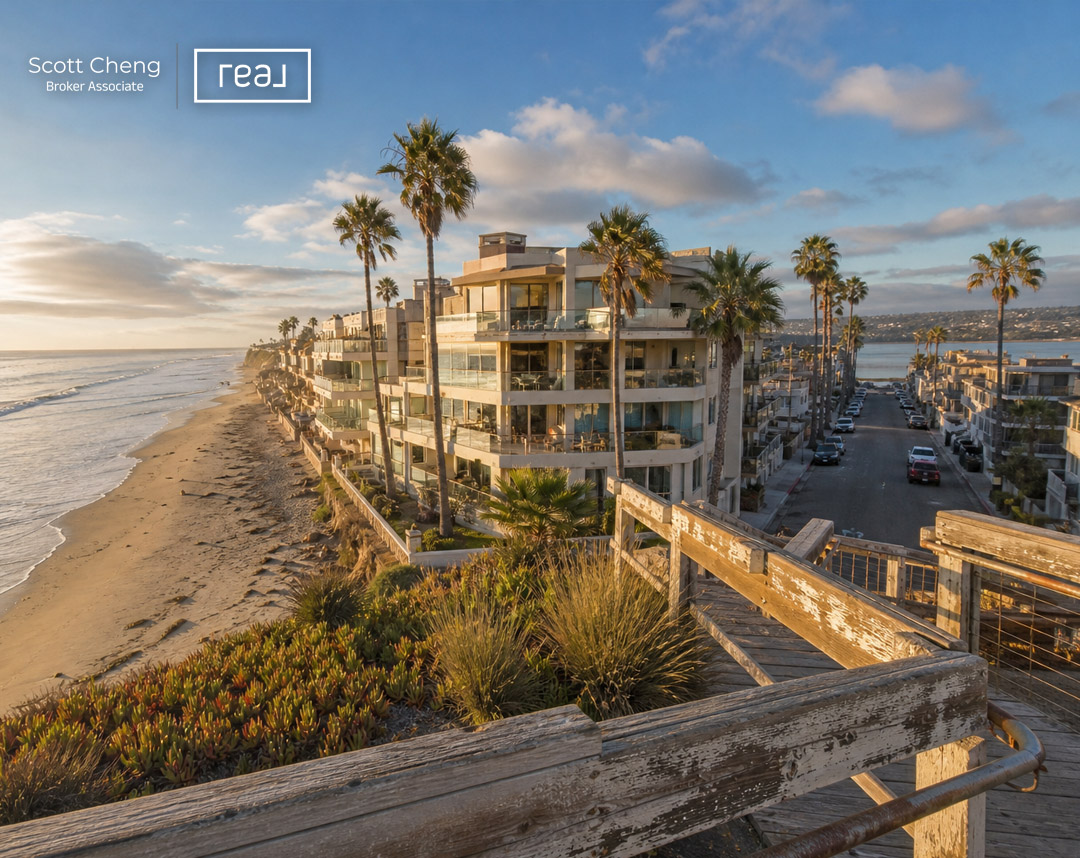
What are the real flood zone and sea level rise risks of buying a waterfront condo in Mission Beach, San Diego, in 2026, and how does that affect your mortgage and insurance costs as a first-time buyer?
As of March 2026, FEMA reclassified most of Mission Beach into high-risk Special Flood Hazard Areas, making flood insurance mandatory for any federally backed mortgage. Annual premiums can range from $2,000 to over $10,000, significantly increasing your monthly carrying costs beyond the mortgage itself.
Why This Matters for San Diego Waterfront Buyers Right Now
If you’ve been browsing waterfront condos in Mission Beach, you probably fell in love with the lifestyle first and started asking the hard questions second. That’s completely normal. But something significant changed on March 3, 2026, and if you’re not aware of it, it could reshape your entire purchase plan.
Updated FEMA Flood Insurance Rate Maps took effect across San Diego’s coastal communities, reclassifying South Mission Beach, North Mission Beach, Pacific Beach, Bird Rock, and La Jolla Shores from low or moderate risk zones to high-risk Special Flood Hazard Areas. According to guidance from the Consumer Finance Bureau on finding the right home, most coastal properties that previously had no mandatory flood insurance requirement now fall within zones carrying a 1% annual chance of flooding.
What I tell my clients is simple: a cloudy mind can’t make decisions. So let’s get the facts on the table, understand the real numbers, and then figure out whether a Mission Beach condo still makes sense for your situation.
What the FEMA Flood Zone Reclassification Means for Your Mission Beach Condo Purchase
Here’s what actually happened. FEMA updated its Flood Insurance Rate Maps for San Diego County, and properties throughout Mission Beach transitioned from Zone X (low to moderate risk) into Zones AE and VE (high risk). Zone VE is the more severe designation, covering areas subject to coastal high-velocity wave action.
For you as a first-time buyer, the practical impact is immediate:
- Mandatory flood insurance is now required for any federally backed mortgage (FHA, VA, or conventional conforming) on properties in these zones
- Your lender will not close without proof of active flood coverage
- New construction and substantial improvements must comply with federal elevation regulations under 44 CFR Part 60.3
- Some lenders may hesitate to finance properties in VE zones altogether, which could narrow your loan options
One first-time buyer I recently worked with had their heart set on a South Mission Beach unit steps from the boardwalk. When we pulled the updated FEMA maps, the property sat squarely in a VE zone. It didn’t kill the deal, but it completely changed the financial picture, adding roughly $6,200 per year in flood insurance. That’s over $500 a month they hadn’t budgeted for.
Can you dispute the designation? Technically, yes. Property owners can apply for a Letter of Map Amendment or a Letter of Map Revision Based on Fill. But for waterfront condos on a narrow sand spit between the Pacific Ocean and Mission Bay, a successful challenge is unlikely.
How Flood Insurance Costs Affect Your Monthly Budget in San Diego
So what are you actually looking at in dollar terms? Under FEMA’s Risk Rating 2.0 methodology, premiums are now calculated based on property-specific factors: distance to the water source, building elevation, construction type, and replacement cost.
For waterfront condos in Mission Beach sitting in AE or VE zones, annual premiums typically range from approximately $2,000 to $10,000 or more. The City of San Diego notes that residents may access loan programs through the Department of Housing and Urban Development, since San Diego renewed its FEMA floodplain management compliance in December 2019. However, the lower NFIP rates (sometimes under $400 per year) generally apply to low and moderate risk zones, not the high-risk SFHAs that now cover Mission Beach.
Let me put this in context. The San Diego County condo and townhome median sits at $675,000 as of early 2026. If you’re financing at the current average 30-year fixed rate of around 6.33% with 10% down, your monthly principal and interest alone is roughly $3,780. Now layer on:
- HOA dues (typical for Mission Beach condos: $300 to $600/month)
- Homeowner’s insurance ($100 to $200/month)
- Flood insurance ($170 to $830+/month depending on risk rating)
- Property taxes (roughly 1.1% of purchase price annually)
That flood insurance line item is no longer negligible. It’s potentially the difference between qualifying for the loan and not.
Sea Level Rise Projections and Long-Term Value in Mission Beach
Beyond the immediate insurance question, there’s the longer-term picture. And if you’re taking on a 30-year mortgage, this matters.
According to Scripps Institution of Oceanography at UC San Diego, sea levels in San Diego have risen about 6 inches since 1970 and are projected to rise up to 0.8 feet by 2050. By 2100, projections range from 1.6 to 6.7 feet of rise. Federal researchers project 10 to 12 inches of additional sea level rise along the U.S. coast between 2020 and 2050.
Mission Beach is uniquely vulnerable because it’s a narrow sand spit. Even modest increases in sea level amplify flooding frequency, extend flood duration, and push water farther inland. The City of San Diego acknowledged this directly when the City Council voted 8-0 in September 2025 to adopt the Coastal Resilience Master Plan, which identifies Mission Beach as one of six priority locations for nature-based solutions projects.
Here’s the honest assessment. Sea levels along San Diego’s coast are expected to rise 5 to 14 times faster this century than last, with $208 to $370 million in public coastal assets at risk by 2050. By July 2026, new city guidance incorporating updated sea level rise scenarios and refined erosion modeling is expected to be finalized.
What does that mean for your property value? Having closed over 275 transactions across San Diego County over 16 years, I’ve watched how risk perception affects resale. Properties in zones with increasing environmental exposure tend to see softer appreciation and a smaller buyer pool over time, particularly as insurance costs climb and lending standards tighten.
What Your Lender Will Require Before Closing on a Mission Beach San Diego Condo
Your lender isn’t going to leave any of this to chance. Here’s the sequence of events you should expect:
- Flood zone determination: Your lender orders a flood zone certification. If the property falls in an SFHA, flood insurance is non-negotiable.
- Proof of insurance before closing: You’ll need to provide an active flood insurance policy (or a binder at minimum) before escrow can close.
- HOA master policy review: For condos, your lender will also review whether the HOA carries a building-wide flood policy. If the coverage is insufficient, you may need a supplemental unit-owner policy.
- Warrantability concerns: Some condo buildings in high-risk flood zones may face “non-warrantable” status with conventional lenders, meaning you’d need portfolio or jumbo financing, which can carry different terms.
One couple I guided through a purchase in Pacific Beach ran into exactly this. The HOA’s master flood policy had a deductible so high that their lender required a separate unit-owner policy. It added three weeks to escrow and another $3,100 annually. With 180 five-star client reviews, I’ve seen enough of these situations to know that preparation upfront saves time, money, and stress on the back end.
Comparing Mission Beach to Other San Diego Waterfront and Coastal Neighborhoods
If the flood risk and insurance costs in Mission Beach give you pause, it’s worth considering how other San Diego neighborhoods compare.
- North Park (ZIP 92104): Year-to-date condo median of $495,000. Inland location means no flood zone concerns. Walk Score of 86 with craft breweries and restaurants lining 30th Street. No mandatory flood insurance required.
- South Park (ZIP 92102): Detached home median of $806,000, selling above asking at 100.7% of list price. Character-filled Craftsman homes on tree-lined Fern Street, well away from any coastal flood exposure.
- Clairemont Mesa, Mira Mesa, and University City: These neighborhoods offer condo options below the county median with zero flood zone complications for most properties.
The San Diego condo market overall posted a median of $675,000, down 1.5% year-over-year, which means you have options. The 2026 FHFA conforming loan limit for San Diego County is $1,104,000, so most purchases qualify for conventional pricing.
As an Associate Broker with Real Brokerage and a top real estate agent for first-time buyers in San Diego, I help buyers weigh these tradeoffs clearly. The waterfront lifestyle is compelling, but the financial picture has to work too.
Frequently Asked Questions
Is flood insurance required for all Mission Beach condos in 2026?
Yes, if you’re using any federally backed mortgage (FHA, VA, or conventional conforming). The March 2026 FEMA map update reclassified Mission Beach into high-risk Special Flood Hazard Areas. Your lender will require proof of flood insurance before closing, and the policy must remain active for the life of the loan.
How much does flood insurance cost for a Mission Beach waterfront condo?
Under FEMA’s Risk Rating 2.0, premiums are individually calculated. For high-risk Mission Beach properties, annual premiums typically range from $2,000 to over $10,000 depending on elevation, distance to water, and building replacement cost. This adds $170 to $830 or more per month to your housing expenses.
Can I buy a Mission Beach condo without flood insurance?
Only if you pay all cash. Any federally backed mortgage requires flood insurance for properties in Special Flood Hazard Areas. Even with a cash purchase, going without coverage means you’re self-insuring against a risk that FEMA considers significant.
What is the difference between Zone AE and Zone VE in San Diego?
Zone AE designates areas with a 1% annual chance of flooding. Zone VE adds the additional hazard of high-velocity wave action from coastal storms. VE zones carry higher insurance premiums and stricter construction requirements. Many Mission Beach oceanfront properties fall in VE zones.
How much has sea level risen in San Diego, and what’s projected?
Sea levels in San Diego have risen approximately 6 inches since 1970. Projections indicate up to 0.8 feet of additional rise by 2050, and between 1.6 and 6.7 feet by 2100. These projections are based on data from Scripps Institution of Oceanography at UC San Diego.
Will flood risk lower property values in Mission Beach?
Increasing insurance costs and tightening lending standards can narrow the buyer pool over time, which generally softens appreciation compared to non-flood-zone neighborhoods. The city’s Coastal Resilience Master Plan aims to mitigate some risks, but long-term sea level rise introduces uncertainty that inland properties don’t carry.
What is San Diego’s Coastal Resilience Master Plan?
Adopted by City Council in September 2025 with an 8-0 vote, this plan identifies nature-based solutions for coastal areas including Mission Beach. Updated guidance incorporating sea level rise scenarios is expected by July 2026. It represents the city’s strategic response to accelerating erosion and flooding.
Can I dispute my property’s FEMA flood zone designation?
You can apply for a Letter of Map Amendment (LOMA) or Letter of Map Revision Based on Fill (LOMR-F). However, for waterfront condos on Mission Beach’s narrow sand spit, a successful challenge is unlikely given the area’s genuine flood exposure and low elevation.
Are there San Diego neighborhoods with waterfront feel but no flood zone risk?
Several San Diego communities offer proximity to water without the high-risk SFHA designation. North Park, with its Walk Score of 86 and condo median of $495,000, gives you urban energy within a short drive of the coast. Neighborhoods like Clairemont Mesa and University City offer similar advantages.
What should I ask my real estate agent about flood risk before making an offer?
Ask for the specific FEMA flood zone designation of the property, request a flood zone certification, review the HOA’s master flood policy and its deductible, get a preliminary flood insurance quote before writing your offer, and inquire about the building’s warrantable status with conventional lenders.
The Bottom Line
Mission Beach remains one of the most desirable waterfront locations in all of San Diego. The lifestyle is real. But the March 2026 FEMA reclassification changed the financial equation in ways that every first-time buyer needs to understand before writing an offer. Flood insurance is now mandatory, premiums can add hundreds per month, and long-term sea level rise introduces uncertainty that deserves honest evaluation.
My approach with every client is clarity first. I want you to see the full picture, the costs, the risks, and the alternatives, so you can move forward with confidence rather than anxiety. If you’re weighing a Mission Beach condo against other San Diego neighborhoods, or if you simply want someone to walk through the numbers with you, I’m here to help. You can reach me, Scott Cheng, at 858-405-0002 or through my office at 16516 Bernardo Center Dr. Ste. 300 in San Diego. With 16 years of experience and an Associate Broker license (DRE# 01509668), I’ll make sure you have clean information and a calm plan before you make one of the most important financial decisions of your life.
Have Questions About San Diego Real Estate?
Scott Cheng provides free, no-obligation consultations for buyers, sellers, and investors.
Schedule a Consultation