

How to Price Your San Diego Home Correctly in 2026: Detached vs. Attached Property Strategies
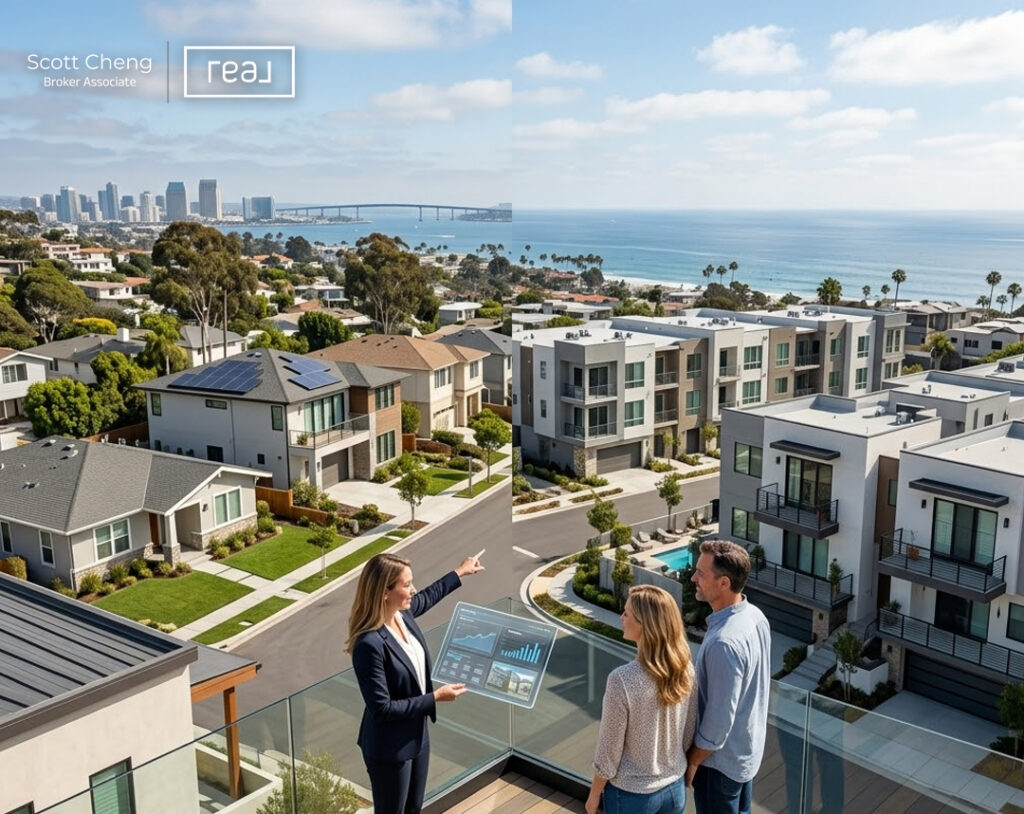
# How to Price Your San Diego Home Correctly in 2026: Detached vs. Attached Property Strategies
How do you price your San Diego home correctly in 2026, and what should you do differently for detached homes versus condos and townhomes?
[SNIPPET ANSWER: Price detached homes near market value to spark competition, then let demand push you over list. Price attached homes more aggressively to outcompete similar units. Use 18-day average DOM, 0.993 sale-to-list, and type-specific trends to calibrate.]
Why This Matters Right Now
You are pricing into a market that still favors you, but only if you read the signals correctly. Inventory sits near 3.2 months, sales jumped 22.2% from January to February 2026, and homes average 18 days on market. Yet the median sale-to-list ratio is 0.993 and more than half of sales close under list. Detached homes are appreciating about 2.1% year over year at a median of roughly $1,089,795. Attached homes are sliding about 2.2% with a median near $660,000. That split means your pricing strategy must reflect your property type, not the county headline. You also face more competition as inventory builds from last year’s lows. Your timing, pricing band, and first 10 days on market will determine whether you create urgency or chase the market down.
What You Need to Know Before Pricing in 2026
You should anchor your price to today’s demand velocity and type-specific trends, not last year’s headlines. You are working with a fast but discerning buyer pool that expects value clarity.
- Detached homes are gaining ground. You can price near true market value and rely on demand to create lift.
- Attached homes face more competition. You should price to steal attention from similar units in the same complex and nearby alternatives.
- The average days on market is about 18 days. If you exceed that without strong activity, you are likely mispriced.
- The sale-to-list ratio is about 0.993. Over a third of homes sell above list, but more than half sell below. Your list price needs to balance visibility and negotiation room.
- Inventory rose materially compared with last year, yet remains tight by historical standards. You should still expect fast feedback from the market.
- Detached median near $1.09M and attached near $660K confirm a split market. You should price within your segment’s reality, not the countywide median.
You should also factor condition, micro-location, school zones, lot utility, outdoor space, parking, HOA dues, and special assessments. These can swing buyer math more than a small list price tweak.
How to Compare Your Options: Detached vs. Attached
You can think of detached and attached as two different games with overlapping buyers. You are aiming to win the right game.
Detached homes:
- Strategy: Price close to fair market value, highlight land, privacy, and outdoor living, then let competition do the rest.
- Why: Year-over-year appreciation near 2.1% and low inventory for quality single-family homes create pricing power.
- Proof points: Faster showing velocity, stronger lifestyle appeal, and scarcity of buildable land support premiums.
- Risk: Overpricing reduces urgency and can flatten the multiple-offer curve in week one.
Attached homes:
- Strategy: Price slightly under the best recent comparable to jump to the top of every buyer’s shortlist.
- Why: Year-over-year price softness near 2.2% and higher unit-to-unit substitutability force you to outposition peers.
- Proof points: Buyers weigh HOA dues, amenities, parking, noise, and unit orientation against multiple near-identical options.
- Risk: Pricing at the top of the stack stalls traffic, then forces cuts that net less than an upfront competitive list.
Key factors to evaluate:
- Price trend by type and submarket, not just countywide medians.
- Comp quality vs. your home’s features, layout, and condition.
- Buyer budget bands and psychological thresholds that determine which search results you appear in.
Your Step-by-Step Guide to Setting the Right List Price
1) Define your comp set You should select 5 to 10 sold comps from the last 60 to 120 days, plus active and pending competition within one mile for detached and within the same complex or immediate area for attached. Match bed-bath count, square footage, lot utility, and condition.
2) Adjust for features that buyers pay for You should price-in premiums for usable yard space, views, privacy, recent remodels, EV-ready garage, solar ownership, and ADU potential or permits. For condos, prioritize orientation, quiet side, storage, parking count, in-unit laundry, and amenity quality.
3) Choose the right price band You should slot just below natural search ceilings. Common bands cluster at round numbers. For example, $1,099,000 will often outperform $1,110,000 because it captures buyers searching up to $1.1M. For attached, clear bands like $649,000 or $699,000 capture more eyeballs than odd numbers.
4) Match strategy to property type You should list detached near fair value. Expect competition to drive terms and price if your first week is strong. You should list attached a notch under the closest superior comp to earn immediate showings.
5) Launch for maximum velocity You should go live midweek, schedule an open-house weekend, and aim to accumulate showings quickly. Professional photos, floor plans, and precise descriptions help you win clicks in the first 72 hours.
6) Monitor week-one signals You should expect strong inquiries and multiple private showings in days 1 to 7 if you are priced well. If you see light traffic, few saves, and no offers by day 10 to 14 in a market averaging 18 days, plan a small, surgical reduction to the next band.
7) Negotiate to net more You should consider buyer credits for rate buydowns, HOA or closing cost assistance, and flexible timelines. Those can preserve your headline price while solving buyer constraints.
What This Looks Like Near 16516 Bernardo Center Dr STE 300
You are selling in North County Inland, where submarkets behave differently block by block. You should tailor your pricing to how buyers shop each neighborhood.
- Rancho Bernardo
You should expect strong detached demand for homes with usable yards and proximity to community amenities. Many detached homes transact around the county detached median or higher, depending on upgrades and lot quality. Condos often compete on HOA value, parking, and quiet locations.
- 4S Ranch and Del Sur
You should lean into family-friendly floor plans, newer construction, and walkability to parks and schools. Detached homes with modern layouts and low maintenance lots can command premiums. Townhomes sell well when they offer two-car garages, outdoor space, and low HOA increases.
- Carmel Mountain Ranch, Sabre Springs, Rancho Peñasquitos
You should emphasize commute access and school zones. Detached homes with updated kitchens and baths, newer roofs, and paid solar pull stronger offers. Condos and townhomes do best when they are move-in ready and priced to edge out nearly identical floor plans nearby.
- Poway
You should price for land utility, privacy, and school prestige. Larger lots and ADU potential are major value drivers for detached. Attached inventory is thinner, so the most updated units can outperform if priced to beat nearby alternatives.
Across these areas, detached homes continue to benefit from limited land and lifestyle appeal. Attached homes win when you deliver the best value proposition on fees, finishes, and convenience.
What Most People Get Wrong About Pricing in San Diego
You might assume a low-inventory market means you can price high and wait. In reality, the first 10 days decide your leverage. If you overshoot, you miss the surge of new-listing traffic, then cut later and net less. You might think the county median tells you where to list. It does not. You should price by property type, micro-neighborhood, and features buyers actually pay for. You might also believe that a bidding war requires deep underpricing. It does not. You should list detached close to fair value in this market, then let urgency lift you. For condos and townhomes, you should price just below the best competing unit to get on every shortlist. Finally, you should not ignore the math of HOA dues, insurance, and rates. Buyers calculate total monthly cost, not just price.
Frequently Asked Questions
Should you price below market to create a bidding war?
You should do this selectively. For detached homes with strong comps and features, pricing near fair value is usually enough to generate multiple offers. For attached homes, a slight undercut of the best comp can quickly surface serious buyers and protect your net.
How long should you wait before adjusting price?
You should reassess at day 7 and again at day 10 to 14. In a market averaging 18 days on market, a quiet first week signals a miss. A targeted reduction to the next price band often restores momentum without overcorrecting.
How do HOA dues affect condo pricing?
You should price in the total monthly cost. Higher dues, special assessments, or insurance increases reduce buyer affordability. If your dues are above nearby alternatives, you should compensate with a sharper list price or better move-in readiness.
What if your appraisal comes in low?
You should plan options before you list. If a low appraisal hits, you can consider small price adjustments, buyer rate buydown credits, or meeting in the middle. Strong early competition reduces the appraisal risk by showing market support.
Are rate buydown credits better than a price cut?
You often net more with a credit. You should compare both scenarios. A modest seller credit to buy down the rate can lower the buyer’s payment more than a similar price drop, and it can preserve your recorded sale price.
The Bottom Line
You are pricing into a split market. Detached homes have the wind at their back, so you should price near fair value and let competition push your terms. Attached homes are value battles, so you should price to beat the nearest superior comp from day one. Use 18-day average market time, a 0.993 sale-to-list ratio, and your property type’s median trend to calibrate. Your first 10 days will set the tone. If you capture attention quickly, you control the negotiation. If you do not, adjust early and precisely. If you’re ready to explore your options for pricing your San Diego home in the 16516 Bernardo Center Dr STE 300 area, Scott Cheng at Scott Cheng – REAL Brokerage can walk you through the specifics for your situation.
 858 405 0002 DRE #01509668