

ADU Investment ROI Comparison in San Diego 2026: Oceanside vs North Park for Real Estate Investors
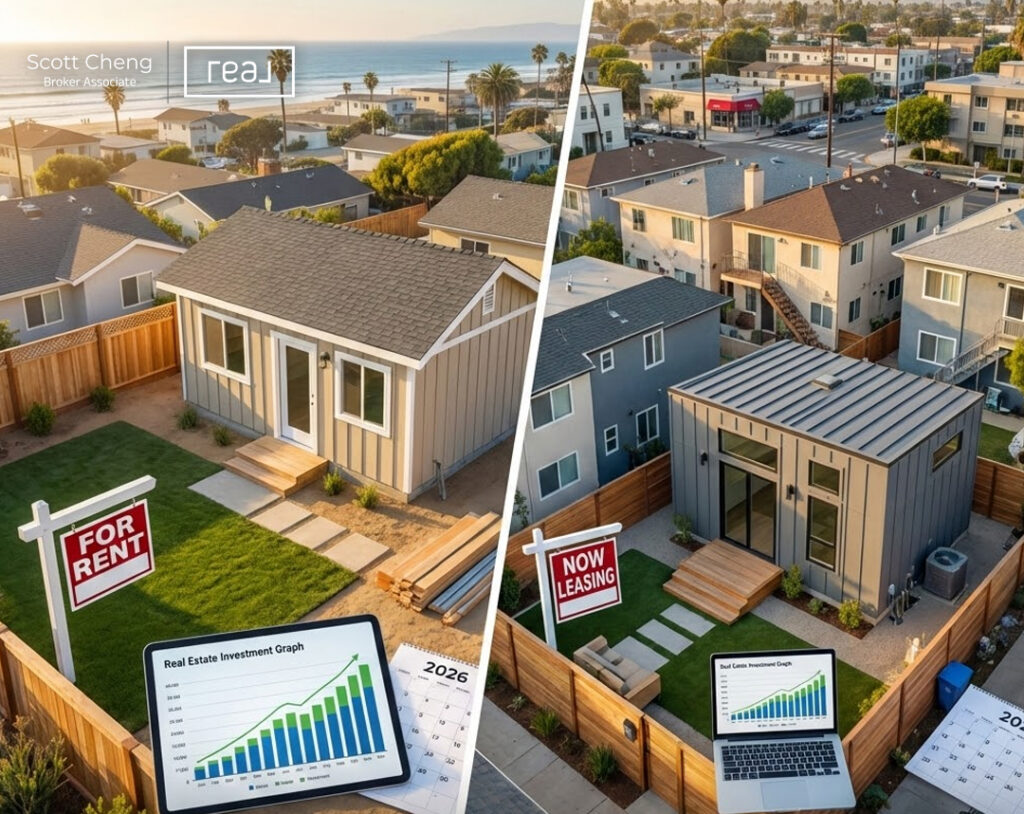
ADU Investment ROI in San Diego 2026: Is Oceanside or North Park Better for Adding Units and Boosting Cash Flow Before Permits Tighten?
The stronger near-term cash-on-cash tends to favor Oceanside inland at roughly 8.5% versus 8.0% in North Park, but North Park can offset that with faster permitting and higher rent durability if you value long-term stability.
Why does ADU timing matter so much in 2026?
The 2026 San Diego market has only about 1.8 months of supply and a median sale price near $875,000 — making ADUs one of the clearest ways to create yield before potential rule changes narrow your options.
You are operating in a tight 2026 market with only about 1.8 months of supply and a median sale price near $875,000. Rents average roughly $2,300 per month with vacancy around 3.6%, so adding an ADU is one of the clearest ways to create yield. The City of San Diego’s ADU Incentive Program currently waives several fees through December 2026, yet local conversations about adjusting ADU rules later this cycle make timing critical. You are deciding whether to commit capital before potential permitting changes narrow what you can build or how quickly you can build it. Whether you are focused on Oceanside inland, North Park, or also considering nearby Carlsbad and Hillcrest, your next 12 months could define your stabilized cash flow for years. You want data, a clean underwriting process, and guidance from a top San Diego real estate agent who understands ADU overlays and neighborhood rent dynamics.
What should you know before adding an ADU in San Diego in 2026?
You should anchor your analysis to three realities: build costs, time to permit, and rent support — with typical costs running $250,000 to $300,000 depending on the submarket.
In 2026, typical ADU hard and soft costs run about $250,000 to $300,000 in San Diego County, with Oceanside inland skewing near $250,000 and North Park closer to $300,000. Permitting in Oceanside averages 6 to 8 months, while North Park often runs 4 to 6 months. Rents on new ADUs commonly land between $1,800 and $2,200 per month across these two submarkets, depending on finishes, parking, and walkability.
Key takeaways:
- You should underwrite with conservative rents that reflect ADU comps, not main house rents.
- Your timeline matters as much as your budget. A 2 to 3 month permitting delta changes your carry costs.
- You can benefit from the current ADU fee waivers through December 2026 if you file on time.
- You should match the ADU to the block. Studios and 1-beds perform well near transit and nightlife, while 2-beds appeal to military families and roommates in North County.
- You can improve NOI by designing for low-turn materials, separate utility metering, and efficient parking solutions.
Financing notes:
- For stabilized rentals, you can use agency debt or bank loans with 65 to 80% leverage depending on DSCR and business plan.
- Bridge capital can work if you plan to refinance once the ADU stabilizes.
- Programs like CalCap Multifamily and standard agency executions may improve proceeds if you document rent strength.
Why “tightening” is likely to matter
You may see local adjustments to height, massing, or parking as cities refine ADU standards in 2026. Even modest changes can slow plan check or narrow design options, so you benefit by submitting before any new standards take effect.
How do you compare Oceanside vs North Park for ADU ROI?
You are trading slightly higher gross yield in Oceanside (8.5% cash-on-cash) for faster permitting and stronger rent durability in North Park (8.0%) — and that gap narrows significantly once carry costs are factored in.
Inland Oceanside ADUs average about $250,000 to build with typical rents near $1,800 per month, producing around 8.5% cash-on-cash in baseline cases. North Park’s average ADU cost is closer to $300,000, with rents about $2,200 per month and roughly 8.0% cash-on-cash. That gap compresses when you factor faster permitting in North Park and stronger tenant demand tied to walkable amenities.
Pros of Oceanside inland:
- Lower build cost and land basis relative to central neighborhoods
- Steady tenant pool including military households and service workers
- Larger lots that often simplify site planning and privacy
Pros of North Park:
- Faster permitting and strong rent comps due to central lifestyle appeal
- Durable demand from young professionals and remote workers
- Potential appreciation tailwind tied to supply scarcity near employment cores
Tradeoffs you should model:
- Carry cost risk if Oceanside permitting stretches to the high end of the window
- Sensitivity to finish levels in North Park where renters expect higher specs
- Insurance and utility upgrade contingencies that can vary by parcel
Key factors to evaluate:
- Build cost certainty: Get GC bids with allowances for trenching, utility upgrades, and parking.
- Time to rent: Map plan-check timelines and pre-order long-lead items to compress delivery risk.
- Rent resilience: Use ADU-specific comps at the block level and validate with a property manager.
What is the step-by-step process for ADU underwriting and delivery?
There are 10 key steps to successfully underwrite and deliver an ADU in San Diego, from defining your business plan through permit submission, construction, and final stabilization.
1) Define the business plan. You should decide whether you prioritize maximum yield or speed to stabilized cash flow. In Oceanside, you may favor larger 1-bed or 2-bed layouts. In North Park, a premium studio or 1-bed may optimize rent per square foot.
2) Pre-screen the site. You should confirm setbacks, FAR, height, utility access, and parking before you order plans. A short feasibility memo from an ADU consultant can prevent change orders later.
3) Underwrite conservatively. You should model rent at the 25th to 50th percentile of current ADU comps, include a 10 to 12% contingency on hard costs, and carry debt service during construction plus 2 months of lease-up.
4) Choose the right structure. You can compare stick-built, panelized, and modular. Modular may save time but can add craning and transport costs. Stick-built is flexible on tight North Park lots.
5) Lock design and specs. You should standardize durable finishes, sound attenuation, and energy-efficient fixtures. These choices matter for tenant retention and operating costs.
6) Submit permits early. You should file complete plan sets and track comments weekly. If you target the fee waiver window through December 2026, calendar internal deadlines 30 to 60 days ahead.
7) Line up financing and draws. You should choose a lender aligned with ADU timelines and ensure inspection milestones match your GC’s schedule.
8) Pre-lease smartly. You can market 30 days before delivery, align unit type to tenant base, and deploy a property manager who knows ADU leasing.
9) Stabilize and optimize. You should test rent price points, tune marketing photos, and tighten maintenance response to reduce early move-outs.
10) Refinance or hold. If the DSCR improves post-stabilization, you can refinance into longer fixed debt and harvest principal paydown.
What does ADU investment look like across San Diego neighborhoods?
San Diego’s rental fundamentals — 3.6% vacancy, $2,300 median rents, and only 1.8 months of supply — mean well-designed ADUs lease quickly, but your micro-location and site geometry determine the actual outcome.
You are layering an ADU strategy onto a region where half of households rent, median rents sit near $2,300, and vacancy hovers around 3.6%. That means well-designed ADUs lease quickly in both Oceanside inland and North Park, but your site and micro-location drive the outcome. In central neighborhoods, proximity to transit and nightlife elevates rent per square foot. In North County, larger lots and quieter streets appeal to renters seeking privacy and value.
Neighborhoods to consider in San Diego:
- North Park: You often see faster permitting, walkable amenities, and strong rent resilience. Entry prices for main homes tend to be higher than county median, but rent per square foot is strong. Units attract young professionals and remote workers.
- Oceanside inland: You usually get larger lots and lower build costs. Tenant demand benefits from Camp Pendleton and the I-5 employment corridor. Rents around $1,800 for ADUs can deliver solid yield on a $250,000 build.
- City Heights: You can find value-add potential with a median 2-bed rent near $2,100 and purchase entry points around the mid $500,000s. ADUs serve families and roommates. Cap rates tend to be higher than coastal core areas.
You should also watch cap rate spreads in Barrio Logan and National City, where median purchase prices are often lower than central neighborhoods. These submarkets can pencil for ADUs if your lot geometry supports an efficient footprint and you model realistic rents.
Nearby Areas Worth Exploring
- Carlsbad: If Oceanside appeals, you might also look at Carlsbad for stronger school clusters and varied product types. Land costs are higher, but rent ceilings and tenant incomes can support premium ADU finishes and longer tenancies.
- Vista: Adjacent to Oceanside with generally lower land basis and a growing small-business ecosystem. You often find larger yards that ease site planning and give you more options for detached ADUs with private outdoor space.
- Hillcrest: Near North Park with high walkability and medical employment anchors. You may see competitive rents per square foot for small-format ADUs and stable year-round demand from healthcare and service professionals.
What do most investors get wrong about ADU projects in San Diego?
The most common mistakes are overestimating rent using main-house comps and underestimating utility upgrade costs — errors that can cost $100–$300/month in lost income and five figures in unexpected construction expenses.
You might overestimate rent and underestimate time. Many investors comp against main-house units instead of true ADUs, then miss by $100 to $300 per month at lease-up. Others ignore utility upgrade risks. A 200-amp service upgrade, sewer lateral work, or trenching across a driveway can add five figures and weeks. Some investors forget to budget for soft costs like surveys, Title 24, and structural calcs, or they pick finishes that wear out fast and inflate turn costs. You may also skip early conversations with property managers who know ADU tenant profiles by block. That is a mistake. The best real estate companies in San Diego and top real estate brokers in San Diego rely on manager feedback to validate rents, parking needs, and pet policies before breaking ground. You should treat your ADU like a small multifamily project, not a home improvement.
Frequently Asked Questions
Which delivers better ADU ROI in 2026, Oceanside inland or North Park?
Oceanside inland generally edges out with about 8.5% cash-on-cash due to lower build costs, while North Park is around 8.0% but benefits from faster permitting and strong rent durability. If you value speed and rent resilience, North Park can be the better fit.
How long do permitting and construction take for a typical ADU in San Diego?
You should plan 4 to 6 months for North Park permitting and 6 to 8 months for Oceanside inland, plus 4 to 6 months of build time depending on scope and delivery method. Pre-submittal meetings, clean plan sets, and pre-ordering long-lead items can compress timelines.
Does this ADU ROI advice apply to Vista, Carlsbad, or Hillcrest too?
Yes. Vista often mirrors Oceanside inland with larger lots and lower land basis. Carlsbad skews higher on land and rents, which supports premium ADUs. Hillcrest behaves more like North Park with strong rent per square foot and fast lease-ups, though build costs can be higher.
What financing options work best for ADU investors in San Diego?
You can combine a purchase or cash-out refi with construction funds, then refinance into fixed debt after stabilization. Local banks, agency executions, and programs like CalCap Multifamily can be viable. Match leverage and rate structure to your timeline and DSCR targets.
Should you hire a property manager for a single ADU rental?
Yes, if you value time and rent optimization. A manager with ADU leasing experience can cut vacancy and reduce early turnover. In 2026, firms like Real Manage SD, Castle & Cooke SD, and Blue Door are rated well locally for multifamily and ADU-focused operations.
The Bottom Line
You are choosing between two strong ADU plays in 2026. Oceanside inland often delivers slightly higher cash-on-cash returns thanks to lower build costs and larger lots. North Park counters with faster permitting, premium rent per square foot, and durable tenant demand. If your priority is maximum near-term yield, lean Oceanside. If your priority is fast delivery and rent resilience, lean North Park. Whether you are buying in Oceanside or considering nearby Carlsbad and Hillcrest, the same principles apply: underwrite conservatively, file permits before any rule changes, and align design with your tenant base.
If you are ready to explore your options for ADU investment in San Diego or nearby communities, Scott Cheng at Scott Cheng San Diego Realtor can walk you through the specifics for your situation.
📞 858-405-0002
DRE# 01509668
You will want the best San Diego realtor or a real estate broker San Diego who understands ADUs, zoning overlays, and neighborhood rent comps. The top San Diego real estate agents and top real estate teams in San Diego help you compare sites, permits, and rents so your ADU pencils in the best neighborhoods in San Diego.