Interest Rate Comparison San Diego Down Payment Assistance Programs 2025
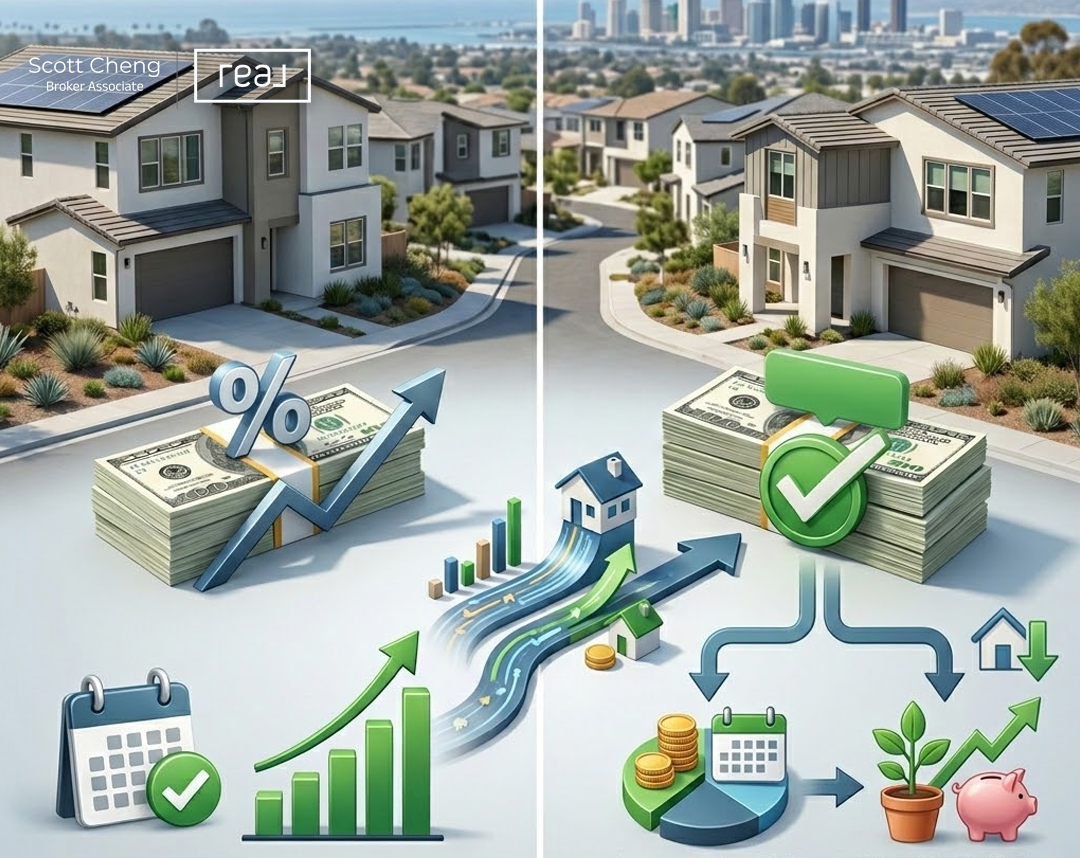
Interest Rate Comparison for San Diego Down Payment Assistance Programs 2025: Which Program Charges 3% Simple Interest and Which Offers Better Terms?
SDHC’s deferred loan charges 3% simple interest. County CalHome is 0% interest and functions as a grant forgiven after 5 years, which usually provides better overall terms if you qualify and can tolerate a slightly slower timeline.
Why does your choice of San Diego down payment assistance program matter right now?
You are competing in a tight market with about 1.8 months of inventory and mortgage rates near 6.4 to 6.5 percent. Your choice of down payment assistance affects what you can afford, how fast you can close, and your total cost over time. In San Diego, the right program can be the difference between winning an offer and watching a home slip away. You are seeing steady pricing, with the median single family home near 900,000 and condos around 550,000. That means every dollar of assistance must work hard. The right interest structure can save you thousands without raising your monthly payment. This guidance also applies if you are considering nearby areas like La Mesa and Chula Vista, where entry price points can be more approachable and program eligibility can differ by jurisdiction.
What do you need to know before comparing San Diego down payment assistance interest rates?
You should focus on three pillars before you compare interest on assistance: eligibility, timing, and total cost. Here is how the two major options stack up based on 2025 to 2026 guidelines and local data.
– Interest: 3% simple interest, deferred until a repayment trigger.
– Triggers: Sale, refinance above the original amount, or income exceeding 140% of area median income.
– Coverage: Up to 15,000 for closing costs.
– Income limits: Roughly 50 to 120% AMI. A 1 person cap sits near 87,200.
– Purchase price caps: About 650,000 for single family and 450,000 for condos.
– Timing: Average processing around 55 days.
– Education: 8 hour HUD approved course, submitted 2 weeks before application.
– Minimum down: Typically 3% from you, which can be gifted.
- County of San Diego CalHome
– Interest: 0% interest, structured as a grant.
– Forgiveness: Forgiven after 5 years if you maintain owner occupancy and comply with rules.
– Coverage: Up to 10,000 for closing costs, plus down payment assistance via CalHome funds.
– Income limits: Approximately 60 to 150% AMI, with a 1 person cap near 109,500.
– Purchase price: No hard countywide cap, but you must meet an AMI based schedule. Unincorporated areas commonly apply.
– Timing: Average processing around 65 days.
– Education: 6 hour course, certificate at application.
– Minimum down: No minimum cash down if grant covers 20% of price.
Quick definitions that shape your bottom line
You pay simple interest only on principal, not on interest. A 3% simple interest loan for 5 years adds 15% of the principal in interest at payoff. A 0% interest grant forgiven after 5 years often costs you nothing if you comply.
How do you compare SDHC vs CalHome interest rates for San Diego home buyers?
You should compare interest structures in the context of speed, eligibility, and out of pocket funds. The 0% grant structure from CalHome is usually better financially than 3% simple interest. Still, SDHC may fit better when you need faster processing, when your property is inside City of San Diego limits, or when you want up to 15,000 in closing costs.
Here is a quick scenario comparison:
- Borrow 50,000 via SDHC at 3% simple interest and repay in 6 years after a sale. Interest equals 50,000 x 0.03 x 6, which is 9,000. Your monthly payment does not change since repayment is deferred, but you owe principal plus 9,000 when you trigger repayment.
- Receive 50,000 in CalHome grant support at 0% and remain owner occupied for 5 years. If you comply, the assistance is forgiven. Your out of pocket at payoff is 0 for interest, and the grant is not repaid after forgiveness.
When you evaluate, match the program to your path:
- If you plan to move or refinance within 3 to 5 years, the 0% grant can be optimal if you expect to stay owner occupied through year five.
- If your property is within City of San Diego and your price point fits SDHC caps, the SDHC loan may be the only viable route.
- If you need a quicker close to beat competing offers, SDHC’s average 55 day timeline can be a practical advantage.
Key factors to evaluate:
- Eligibility window: Compare your AMI, purchase price, and location rules side by side.
- Timeline control: Weigh 55 days vs 65 days and align with your offer deadlines.
- True cost: Model simple interest cost over your expected hold period vs 0% forgiveness.
What is the step-by-step process for choosing a San Diego down payment assistance program?
You can stack the odds in your favor by sequencing your work before you write offers.
1) Map your budget and AMI.
Use your gross household income to see where you fall relative to city and county AMI bands. This anchors which program you can actually use.
2) Pick your primary mortgage type.
Conventional sits near 6.4% and FHA near 6.0%. The program must layer cleanly with your first mortgage underwriting, especially on debt to income and reserves.
3) Confirm geography early.
If you are buying inside City of San Diego limits, you will likely lean SDHC. If you target unincorporated areas, CalHome may open up 0% grants. Ask your lender to verify the address against program maps before you tour.
4) Complete your education requirement now.
Finish the 8 hour SDHC course or 6 hour CalHome course before you bid. You will avoid last minute delays that kill deals in multiple offer situations.
5) Gather documentation once.
Tax returns, pay stubs, bank statements, and gift letters are often required by both your lender and the assistance provider. Build one complete packet to save time.
6) Get lender and program preapprovals aligned.
Ask for turn times in writing. Aim for program approval within your offer’s contingency periods. In a 30 day offer window, you will likely need a program pre approval letter ready to present.
7) Model your payoff path.
If you could sell or refinance within 5 to 7 years, calculate simple interest cost for SDHC vs full forgiveness under CalHome. Choose the structure that leaves you with the most equity at exit.
What does San Diego’s housing market mean for your down payment assistance program choice?
You face a median single family price near 900,000 and a median condo near 550,000. That context matters because SDHC caps sit near 650,000 for single family and 450,000 for condos. In many central neighborhoods, single family homes exceed SDHC caps, and condos can also sit above the 450,000 cap. CalHome can be powerful in eligible unincorporated areas since it uses an AMI based purchase schedule with more room at entry price points.
In practice, you will often use SDHC when buying within City of San Diego limits. When you explore unincorporated communities, you can unlock CalHome’s 0% grant, which is usually the better long term cost if you plan to stay at least 5 years. For competitive offers, SDHC’s slightly faster average timeline may help you win.
Neighborhoods to consider in San Diego:
- North Park: Walkable lifestyle with condos commonly 500,000 to 700,000 and townhomes on the higher end. Great for first time buyers who want nightlife and cafes. Check SDHC condo caps carefully here.
- Mission Valley: Condo heavy market around 500,000 to 700,000 with transit access. You can often align SDHC support with a well priced condo and keep commutes easy.
- Linda Vista and Clairemont: Mix of entry level single family and townhomes. Pricing can stretch SDHC caps for single family, so you should evaluate condos or townhomes that meet limits.
Nearby Areas Worth Exploring
You might widen your search to adjacent areas where values, schools, or commute patterns fit your life. In some cases, geography can also unlock CalHome where SDHC is not available.
- Poway: Strong schools and suburban feel. Price points for single family often exceed city caps, but townhomes can work. You will appreciate quick freeway access and parks if you want a quieter setting.
- La Mesa: Historic streets and village vibe with condos and smaller single family homes that can be more approachable. You can find units closer to the 500,000 to 650,000 band with trolley access.
- Chula Vista: A range of neighborhoods from West Chula Vista to Eastlake with newer townhomes and single family options. You get family friendly amenities and a variety of price points.
What do most buyers get wrong when comparing San Diego down payment assistance programs?
You might think the interest rate on assistance is the only number that matters. In reality, it is the total effective cost over your expected ownership that decides the winner. A 0% grant that is forgiven in 5 years can beat a 3% simple interest loan by thousands, but only if you hold long enough and comply with occupancy rules. Another common mistake is ignoring purchase price caps and geography until after you fall in love with a home. If you are shopping inside City of San Diego, SDHC may be your only public option, so you need to target properties that actually fit its limits. Many buyers also start the education course too late and lose time during escrow. You should complete your course and assemble your documentation before touring. Finally, you should confirm whether your lender can process your chosen program on your timeline. Not all lenders move at the same speed, and a 10 day gap can be the difference in a multiple offer race.
Frequently Asked Questions
Which San Diego down payment assistance program charges 3% simple interest?
SDHC’s deferred loan charges 3% simple interest. Interest does not compound and accrues on the original principal only. You normally repay when you sell, refinance above the original amount, or your income exceeds the designated threshold.
Is the 0% CalHome grant always better than SDHC for San Diego buyers?
Usually yes if you qualify and remain owner occupied through the forgiveness period. A 0% grant forgiven after 5 years typically beats any positive interest cost. If you need to close faster or your property is inside City of San Diego limits, SDHC may still be the practical choice.
Does San Diego down payment assistance program guidance apply to Poway, La Mesa, and Chula Vista?
Yes, the same decision logic applies. You should verify geography because some county programs focus on unincorporated areas, while city programs focus on properties inside city limits. Price caps, timelines, and course requirements remain the core trade offs to compare.
Which San Diego down payment assistance program covers more closing costs and how fast can you close?
SDHC typically covers up to 15,000 in closing costs with average processing near 55 days. CalHome usually covers up to 10,000 and averages around 65 days. If your offer timeline is tight, SDHC can be easier to fit inside your contingencies.
What happens to your San Diego down payment assistance if you plan to refinance in 3 years?
If you expect to refinance before 5 years, a 0% grant may not be fully forgiven and rules can require repayment if you do not meet occupancy terms. In that case, model SDHC simple interest cost over 3 years against any partial grant benefits and choose the lower exit cost.
What are the income and purchase price limits for SDHC and CalHome in San Diego?
SDHC income limits run roughly 50 to 120% AMI with a 1-person cap near $87,200, and purchase price caps sit near $650,000 for single family homes and $450,000 for condos. CalHome income limits run approximately 60 to 150% AMI with a 1-person cap near $109,500 and no hard countywide purchase price cap. Unincorporated county areas commonly qualify for CalHome.
The Bottom Line
You should anchor your decision on both cost and speed. SDHC charges 3% simple interest with faster average processing and higher closing cost coverage. County CalHome is 0% interest and often forgiven after 5 years, which is usually the better long term deal if you are eligible and plan to stay. Your location, price point, and timeline determine which one actually gets you the keys. Whether you are focusing on San Diego or also considering nearby La Mesa and Chula Vista, the same framework applies: verify eligibility, lock your education certificate early, and model your 5 to 7 year exit to see which structure leaves you with more equity.
If you are ready to explore your options for down payment assistance interest rates in San Diego or nearby communities, Scott Cheng at Scott Cheng San Diego Realtor can walk you through the specifics for your situation.
📞 858-405-0002
DRE# 01509668
Have Questions About San Diego Real Estate?
Scott Cheng provides free, no-obligation consultations for buyers, sellers, and investors.
Schedule a Consultation