

University City vs Pacific Beach: 2026 First-Time Buyer Guide for Value Homes in San Diego
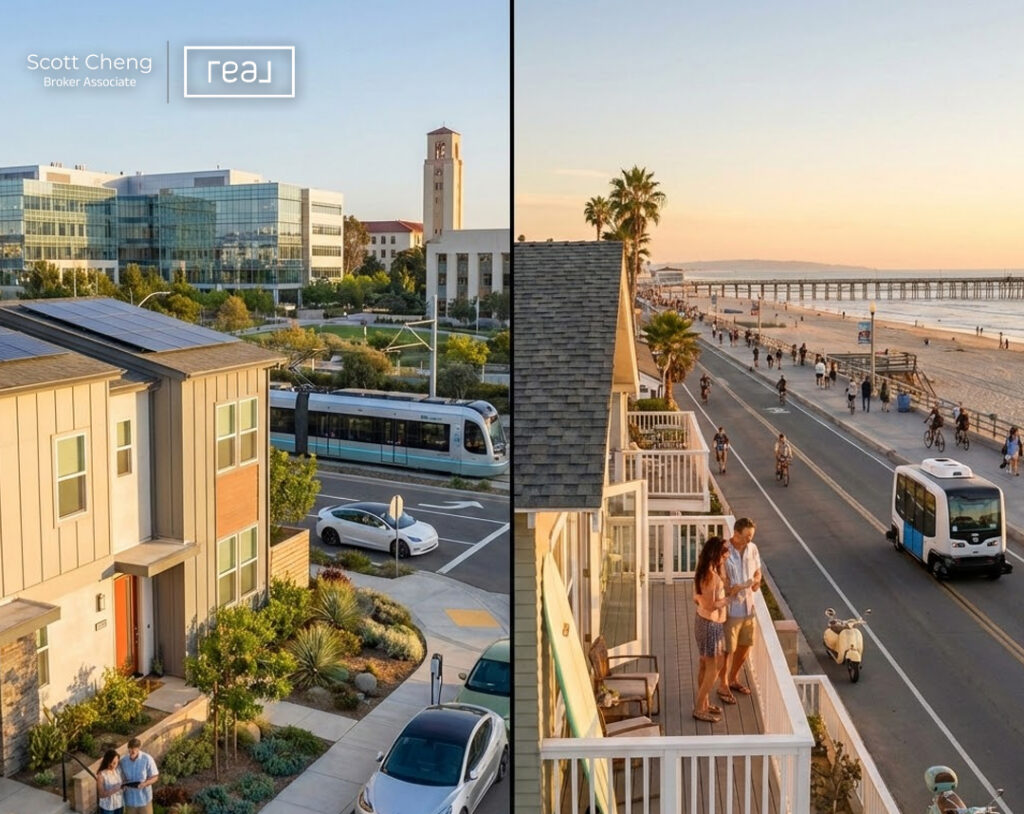
University City vs Pacific Beach: 2026 First-Time Buyer Guide for Value Homes in San Diego
The short answer: choose University City for better value, easier commutes to UCSD and biotech jobs, and quieter condo communities. Pick Pacific Beach if you want walk-to-beach living, active nightlife, and higher long-term rental demand.
Why are first-time buyers choosing between University City and Pacific Beach in 2026?
You are buying into a market that is shifting in your favor, and timing your offer in the right neighborhood can save you thousands. County median prices sit near $901,000 as of January 2026, while inventory has improved and the 30-year fixed rate hovers near 6.11 percent per Freddie Mac.
That combination improves your negotiating power, shortens your time-to-close, and broadens your options under $800,000. You will still see multiple offers on turn-key listings, but you can structure credits, buydowns, and repairs more effectively than a year ago. This decision matters because University City and Pacific Beach are both top San Diego neighborhoods to live, yet they deliver different value per dollar, HOA profiles, commute patterns, and lifestyle tradeoffs. You will also find similar dynamics nearby in La Jolla and Clairemont, so your framework here applies if you pivot a few blocks inland or up the coast.
What do you need to know before choosing between University City and Pacific Beach?
You should define your must-haves by budget, commute, and HOA tolerance before you tour. Here is a side-by-side breakdown of what you will actually encounter in each market.
- Prices and property types you will actually see:
– University City: Many 1 to 3 bed condos and townhomes from about $600,000 to $750,000, with a median condo near $650,000. Inventory clusters near UTC and along the Blue Line trolley.
– Pacific Beach: More 1 to 2 bed condos between roughly $650,000 and $800,000, with a median condo closer to $700,000. Units near Sail Bay and Crown Point trade at a premium.
- Commute and access:
– University City gives you a 10-minute shuttle access to UCSD, frequent bus service, and about an 18-minute drive to downtown via I-5 in typical traffic.
– Pacific Beach puts you 15 minutes to downtown by express bus in favorable conditions, with quick access to I-5 and Mission Bay corridors.
- Monthly cost drivers you must budget:
– Property taxes near 1.1 percent of assessed value.
– HOA dues commonly $450 to $700 per month on older coastal and UTC condos.
– Insurance and PMI if you put less than 20 percent down.
– Utilities, parking fees at some complexes, and possible Mello-Roos in select communities.
- Lifestyle tradeoffs:
– University City is quieter with more academic and biotech commuters, plus UTC Mall amenities and parks like Marian Bear Reserve.
– Pacific Beach offers beach access, nightlife, and a higher walk score, but more noise and parking constraints.
- Market context:
– Days on market average in the high 20s countywide per local MLS. Inventory has improved, so you can be selective on condition and location.
Your options include stretching for a Pacific Beach condo near the water or locking a larger, quieter University City unit with better commute reliability. Either way, you should scrutinize HOA health, reserves, and rules.
Price and Monthly Payment Snapshot, Early 2026
- University City condo at $650,000 with 5 percent down:
– Loan about $617,500. At 6.11 percent, principal and interest roughly $3,740 per month.
– Taxes about $596 per month. HOA commonly $450 to $650. PMI often $200 to $350. Insurance $50 to $90.
– Estimated total housing payment often $4,950 to $5,430 before utilities.
- Pacific Beach condo at $700,000 with 5 percent down:
– Loan about $665,000. Principal and interest roughly $4,030 per month.
– Taxes about $642 per month. HOA often $500 to $700. PMI $220 to $370. Insurance $60 to $100.
– Estimated total housing payment often $5,450 to $5,940 before utilities.
Use the 28 percent front-end rule. If your gross monthly income is $12,000, you will want your housing costs at or below about $3,360. You can exceed that if you have minimal other debt, but underwriters will cap you near 36 percent total debt-to-income.
How do you compare University City vs Pacific Beach for value, commute, and lifestyle?
You should weigh University City versus Pacific Beach on value, commute certainty, and life outside your front door. Each neighborhood has clear strengths and real tradeoffs.
University City strengths:
- Better value per dollar in 2026 at the $600,000 to $700,000 range.
- Quick access to UCSD, Sorrento Valley, and UTC employment corridors.
- Newer construction pockets and solid building systems in many complexes.
- Quieter evenings and easier on-street parking in most micro-areas.
Pacific Beach strengths:
- Walk-to-beach lifestyle, Mission Bay access, and high walkability.
- Strong long-term renter demand in select complexes with looser rental caps.
- Social and dining scene that stays active most nights.
University City tradeoffs:
- Fewer true ocean-view options.
- Some complexes have higher HOA dues due to amenities and age-related maintenance.
- Rental caps more common, which can restrict house hacking.
Pacific Beach tradeoffs:
- More nightlife noise and weekend parking pressure.
- Salt-air wear on exteriors and railings, which adds maintenance.
- Prices run higher near the water for similar interior square footage.
Key factors to evaluate:
- Commute reliability: You should test your route at peak hours. University City to downtown is often steadier on I-5 than beach-area surface streets.
- HOA health and reserves: You should review the reserve study, last 24 months of board minutes, special assessments, and insurance coverage.
- Resale and rental policy: You should confirm rental caps, minimum lease terms, and city short-term rental rules. This matters for exit flexibility and long-term appreciation.
What is the step-by-step process for buying your first home in University City or Pacific Beach?
Follow these ten steps to move from search to signed contract with confidence in either neighborhood.
1) Get fully underwritten, not just pre-approved. A top San Diego real estate agent will push your file through desktop underwriting so you can waive financing contingencies faster. In this market, fully underwritten files still beat higher offers with weaker terms.
2) Lock your rate and ask about buydowns. With rates near 6.11 percent, you can evaluate a 2-to-1 buydown or permanent 0.5 point reduction. Have your real estate broker San Diego model payments both ways.
3) Set your hard lines. Decide if you value beach proximity over space and quiet. If you pick Pacific Beach, define the micro-areas you will accept like Crown Point or north PB. If you pick University City, choose UTC east versus west of I-5.
4) Tour at two times. Visit in late afternoon for commute feel and at night for noise checks. You will learn more in 20 evening minutes in Pacific Beach than in any listing description.
5) Inspect for the location’s stress points. In Pacific Beach, watch for salt corrosion, window seal failures, and balcony railings. In University City, check chiller systems, elevator modernization plans, and plumbing line age in larger complexes.
6) Read the HOA. Demand budget, reserve study, master insurance declaration, special assessment history, rental caps, pet rules, and maintenance responsibilities. Your San Diego broker should flag any reserve funding under 50 percent or high deferred maintenance.
7) Structure the offer to win value, not just the house. Ask for seller credits toward closing costs or a rate buydown. Target repairs that affect safety and water intrusion. Use an appraisal gap only when you can cover it from reserves without straining.
8) Line up assistance. CalHFA and San Diego Housing Commission programs can bridge down payment and closing costs. Factor repayment terms and income limits. Pair these with lender credits from top real estate brokers in San Diego when available.
9) Price check the comp set. Use local MLS solds within the past 60 days in the same micro-area. Condos price by building and stack. You will not get a fair read from citywide averages.
10) Rehearse your exit. If you think you will outgrow a 2-bed in three years, choose the unit with better parking, storage, and rental flexibility. That helps with both resale and renting if you keep it.
What does the San Diego condo market look like for first-time buyers right now?
Inventory has improved across the county with roughly two months of supply per local MLS, yet well-priced condos near the coast still draw multiple offers. You will win by pairing strong underwriting with precise micro-area targeting and a clean, credit-rich offer.
Use Freddie Mac’s weekly survey as your rate guardrail, then focus on unit-level value. In the current environment, you can often secure seller credits for repairs or a buydown on listings that sit beyond 21 days.
Neighborhoods to consider in San Diego:
- University City: A smart fit if you want quieter streets, UTC Mall, and quick access to UCSD and Sorrento Valley. Two-bed condos often $600,000 to $700,000. Parks include Marian Bear Reserve and Rose Canyon. Transit via the Blue Line trolley and commuter buses helps reduce car dependency.
- Pacific Beach: Ideal if you want the best beach neighborhoods in San Diego for daily bay walks and sunset access. One to two bed condos typically $650,000 to $800,000 with premiums near Sail Bay and ocean-adjacent buildings. Expect higher weekend activity and tighter parking.
- Clairemont: A practical alternative if you want a starter single-family home under about $800,000. Central location with fast I-5 and I-805 access. Yards, garages, and fewer HOA dues appeal to first-time buyers who want more space and lower monthly fees.
Nearby Areas Worth Exploring
You may also want to evaluate a few adjacent areas that echo these tradeoffs with different price points.
- La Jolla: If you like Pacific Beach’s coastal feel but want top-tier schools and a quieter village vibe, you will find higher prices and more luxury stock. Great for long-term hold value, but entry-level inventory is limited for first-time buyers.
- Bay Park: If you like Mission Bay views without full beach crowds, Bay Park offers townhomes and older single-family homes with strong freeway access. Prices can be friendlier than ocean-adjacent Pacific Beach and commute times to downtown are competitive.
- Mission Beach: If daily beach access is the non-negotiable, Mission Beach offers unmatched sand-side living with very limited inventory. Expect higher prices, stronger short-term rental regulation, and more intense seasonal crowds.
What mistakes do first-time buyers make when choosing between University City and Pacific Beach?
Most first-time buyers get three things wrong in this comparison, and each mistake can cost thousands.
You might assume the beach premium always outperforms inland appreciation. In reality, University City often holds value more steadily because UCSD, UTC employment, and transit create a durable buyer pool through market cycles. You also might underestimate HOA and insurance costs. A $600 per month HOA plus PMI can add over $800 to your monthly payment and change your target list.
Another mistake is skipping the HOA reserve study and special assessment history. A $15,000 per unit balcony or plumbing assessment can erase any negotiated credit and then some. Finally, many buyers do not test commute routes at peak times. A 15-minute estimate on a map can turn into 35 minutes on a Friday evening if you misread surface-street bottlenecks in beach zones. Focus on micro-location, HOA health, and commute reality, not just listing photos. That is how top producing real estate agents in San Diego separate solid buys from shiny distractions.
Frequently Asked Questions
Which area offers better appreciation potential in 2026, University City or Pacific Beach?
You will likely see steadier appreciation in University City due to UCSD, biotech, and transit access that support year-round demand. Pacific Beach can post bigger gains in hot cycles near the water but tends to be more volatile when tourism-driven demand cools.
Is a condo or townhome smarter for a first-time buyer in these neighborhoods?
You should start with a condo if you need lower entry price and prefer lock-and-leave living near amenities. Choose a townhome when you want more space, a garage, and fewer shared systems. Townhomes often carry lower HOA dues and can be easier to finance for reserves-sensitive buyers.
Does this advice apply to La Jolla and Clairemont too?
Yes. In La Jolla, you trade higher prices for elite coastal amenities and schools, so you must vet HOA and view premiums even more carefully. In Clairemont, you can secure a yard and garage under about $800,000, which shifts your budget from HOA dues to maintenance and renovation.
How competitive are offers right now, and can you still negotiate credits?
You can. With inventory up and rates near 6.11 percent, sellers often accept credits for closing costs or rate buydowns on listings that sit beyond two to three weeks. Clean terms and full underwriting still matter, but you do not need to waive every protection to win.
What hidden costs should you expect beyond the mortgage?
You should budget property taxes near 1.1 percent of price, HOA dues in the $450 to $700 range for many condos, PMI if under 20 percent down, and insurance. Add utilities, possible parking fees, and 2 to 5 percent for closing costs. Keep a repair reserve for coastal wear items.
The Bottom Line
If you want the best neighborhood to live in in San Diego on a $600,000 to $700,000 condo budget, University City usually delivers more space, calmer streets, and the easiest commute to UCSD and UTC jobs. If you want beach access, walkability, and an active social scene, Pacific Beach is the best beach neighborhood in San Diego for first-time buyers who can handle higher HOAs and parking tradeoffs.
Your smartest move is to pair full underwriting with building-level diligence, then use seller credits to optimize your monthly payment. Whether you focus on University City, Pacific Beach, or nearby La Jolla and Clairemont, the same framework applies. Work with a real estate agent San Diego CA who knows micro-areas, HOA health, and how to win credits without overpaying. That is how top realtor in San Diego caliber advice helps you land the right home at the right total cost.
If you are ready to explore your options for buying in University City or Pacific Beach in San Diego or nearby communities, Scott Cheng at Scott Cheng San Diego Realtor can walk you through the specifics for your situation.
📞 858-405-0002
DRE# 01509668
Address: 16516 Bernardo Center Dr. Ste. 300, San Diego, CA 92128
You can expect clear guidance, a data-grounded plan, and the same disciplined approach used by top San Diego real estate agents, top real estate teams in San Diego, and the best real estate companies in San Diego to help first-time buyers succeed.